
Following the Yunfu Daily Report into WAYON's Factory
Zero-Silica Quartz, Ultra-Thin Flexible Stone, and a Manufacturing Network That Delivers on a Drawing
On November 10, the digital edition of Yunfu Daily published "A Yunfu Stone Enterprise's 20 Years of Growing in Step with the Canton Fair," reported by Yunfu Integrated Media journalists Shi Shifu and Wang Minghao. It traces WAYON from its first walk into the exhibition hall in 2007 to 2026 — 20 consecutive years and 40 editions without missing a single one — and from a single standard booth tucked against a wall to a custom-built stand in Area B. Its products have moved through four stages: natural stone, agglomerated stone, quartz stone and terrazzo, and now zero-silica quartz and ultra-thin flexible stone. That same year the Canton Fair marked its 70th anniversary: the venue had grown from 9,600 m² to 1.55 million m², and 32,000 exhibitors shared the floor at this edition.
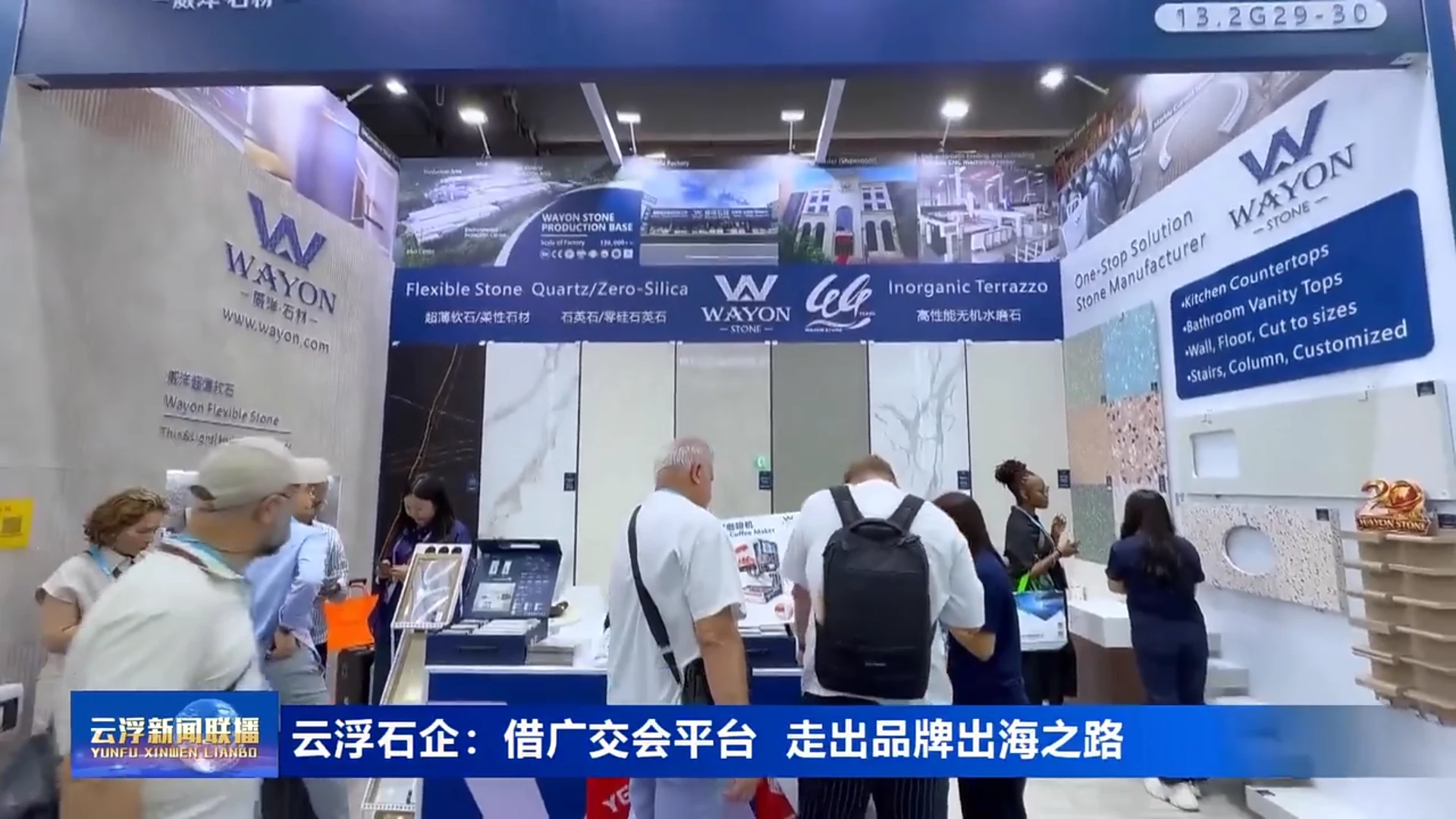
Beyond those 20 years and 40 editions runs a longer timeline: founded in 1982, we have been working with stone in Yunfu for more than four decades. What the stand shows is two decades; what the workshop holds is four. Every shift in booth, product and the questions buyers ask stands on production lines added one by one, and on a room where you can sit down with a drawing and talk for a whole day.
I. Beyond "Never Missing an Edition": Four Decades on the Factory Floor
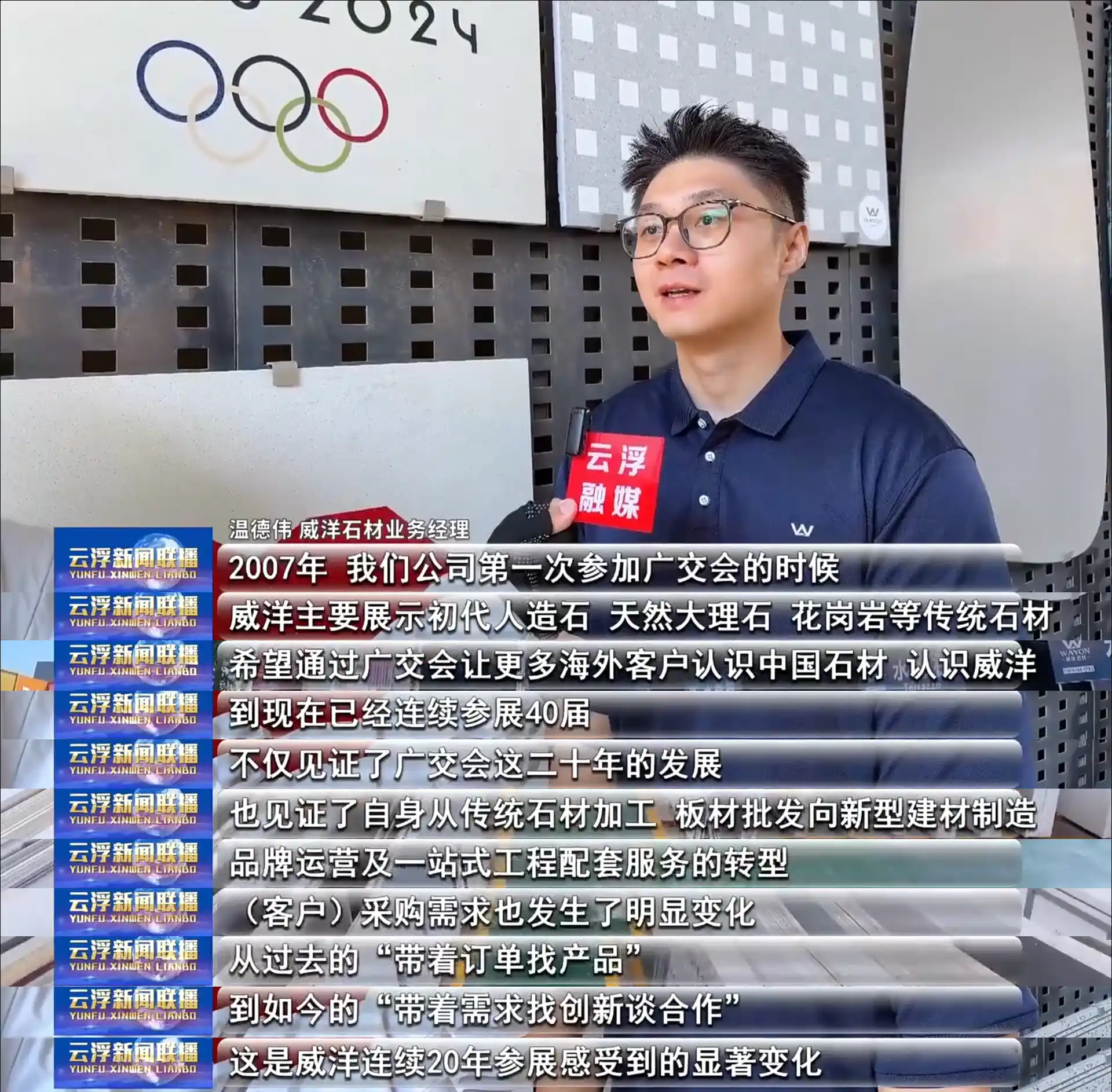
The booth did keep moving: one or two standard positions at first, with simple products and simple displays; later two to four custom-built stands, with attention to brand image, product experience and professional presentation, edging from the corners toward the main aisles. In 2023 the stand sat on a main aisle; in 2024 WAYON was invited to present its brand on the atrium main stage; today it is a custom-built stand in Area B. Forty editions have carried it through the global financial crisis, the pandemic and the shift to online trade, cycle after cycle.
Booths move and exhibits change, but in Yunfu the production lines were added one at a time. We have been at this since 1982 — more than forty years spent on one thing: making stone well. The Yunfu manufacturing base covers around 20,000 m², with 18,000 m² of plant and 2,000 m² of offices and support space. Four automatic pressing lines, one self-developed block-forming line, two quartz transfer-printing lines, one nano-polishing line and two Italian polishing lines connect pressing, curing and polishing into a single flow. As one of Yunfu's earlier bases for engineering quartz and terrazzo, it handles export and project work for kitchens and baths, furniture and commercial spaces, and has always been where zero-silica quartz and transfer-printed quartz move from R&D into volume production.
So "persistence" has two layers: toward the platform, showing up at every edition; toward manufacturing, holding one direction and investing in it for forty years. The first lets the world see us; the second turns being seen into delivered goods. Take either away and those 40 editions would not stand.
II. Zero-Silica Quartz: The Production Line Behind "Below 1%"
Australia was the first to set strict limits on crystalline silica in quartz surfaces, and European countries followed one after another. Zero silica stopped being an entry condition for a single market and became a shared threshold across many. Whether a slab clears customs is no longer decided by a quotation, but by a test report. Zero silica was not a selling point we added on our own initiative; it was a requirement the market handed us first.
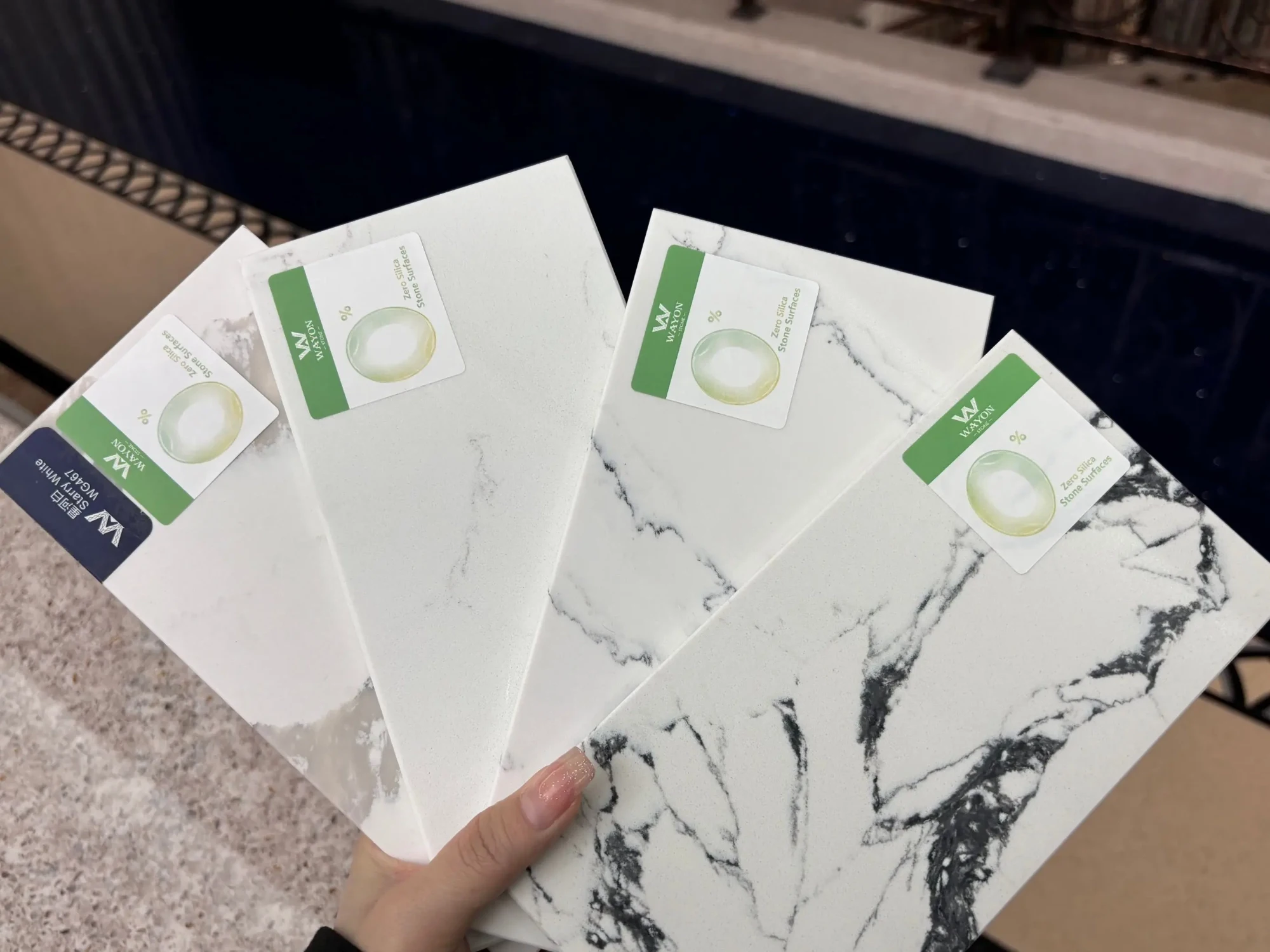
Crystalline silica below 1% — that figure is not the result of one sample. It has to hold true for every batch. The distance between the two is the distance of a production line. We did not stop at "send one sample for testing when the customer asks." Fully automated lines were brought in to stabilize the formulation and pressing conditions, with third-party XRD testing used to hold crystalline silica below 1%. AI-assisted tracking of regulations and standards worldwide, together with SGS third-party testing, EU CE marking and NSF food-contact safety certification, turned compliance into a system rather than a one-off document. "We are not merely meeting requirements passively; we are actively developing solutions." On the factory floor, that simply means the line has already been adjusted before the regulation has finished changing.
Under that system sit capacity and quality control. The Yunfu base handles R&D and volume production of zero-silica and transfer-printed quartz. The Heyuan base of Guangdong WAYON Industrial — 60,000 m² in total, 40,000 m² of plant and a 1,200 m² R&D center, with 16 quartz production lines and 4 automatic polishing lines — carries scaled delivery. Standardized quality management runs from raw materials through production, fabrication, finished goods, packing and delivery, aimed at consistency across multiple categories and multiple batches, not at one batch that happens to look especially good.
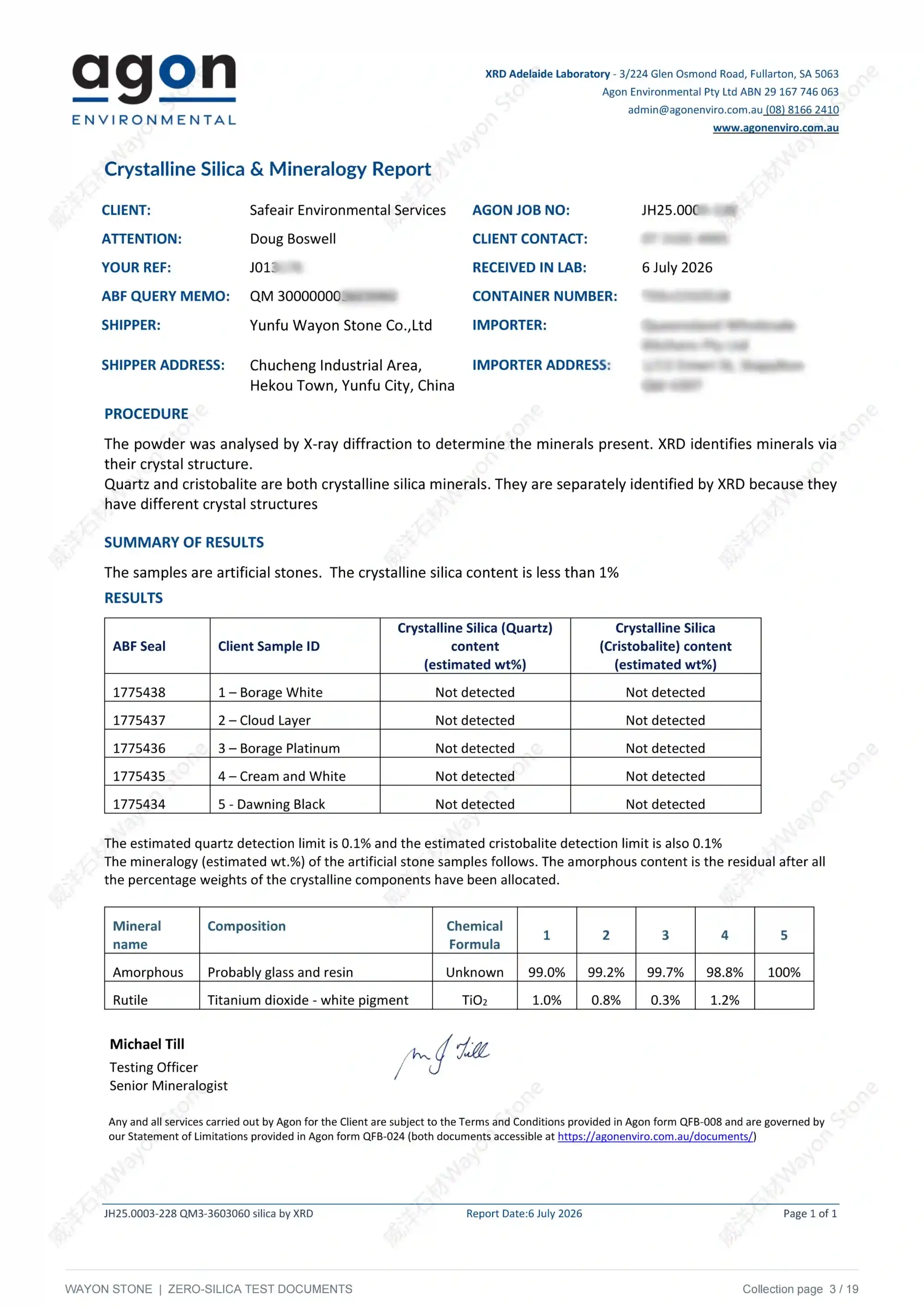
From Australia to markets across Europe, zero-silica inquiries no longer come from one place. Behind a single question lies a whole chain of certification, formulation, production lines and quality control. Whatever the customer asks, the line has to be able to answer.
III. A Stone That Bends: Off the Fully Automated Flexible-Stone Line
Flexible stone redraws the boundaries of traditional stone: it can bend, it can follow a curve, it does not need a dry-hung fixing system to go on a wall, and it asks no extra load from the structure. There was a deeper consideration at the starting point of its development as well: reducing the over- quarrying of natural stone while still delivering the look of natural stone in a greener way. Lightness, flexibility, faithful texture and the stability of batch production, all at once, come from one fully automated flexible stone (MCM Stone) line.
Three hard numbers define it: temperature control within ±1°C, density uniformity above 98%, and texture reproduction above 99%, supporting stable volume delivery at 2–8 mm thickness and made - to-measure dimensions. Each number solves one very specific problem:
- ±1°C addresses warpage and internal stress between thin-slab batches, so a 2 mm sheet still leaves the factory flat.
- 98%+ density uniformity addresses "thin but not brittle" — it can bend, it can wrap a curve, and going on a wall no longer requires dry hanging or extra structural load.
- 99%+ texture reproduction addresses the one that matters most: if the texture is not faithful, "greener" easily becomes "making do." Sparing a mountain only works if the surface the designer wanted is not sacrificed.
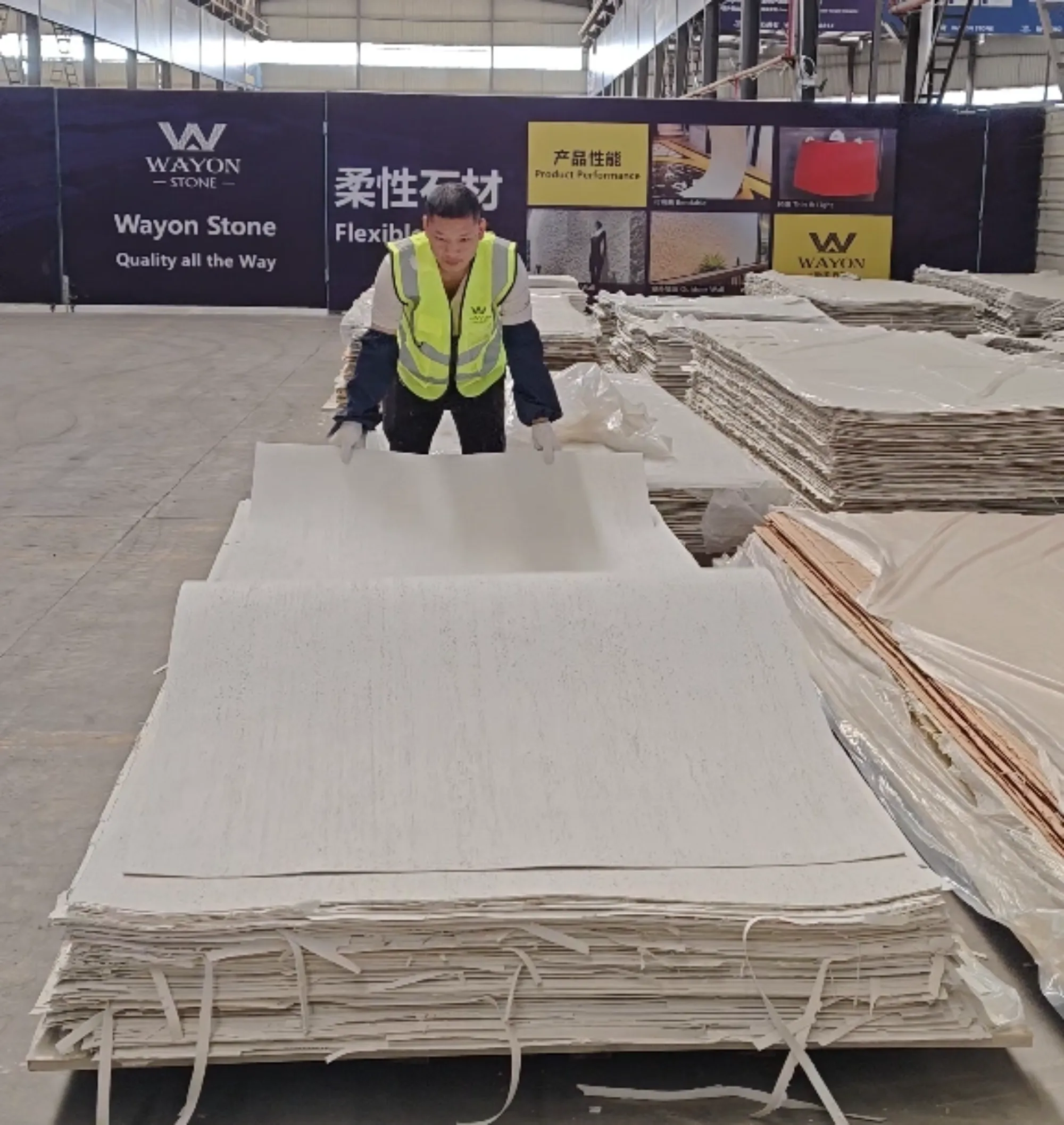
Follow-up questions differ by region, and each has its own target. Europe and the Middle East focus heavily on weatherability and ease of installation — which points to light, thin, dry-hanging-free. North America cares more about design effect and construction fit — which points to texture reproduction and dimensions customized to the drawing. A stone that bends becomes a solution rather than a material not because it bends, but because it can be produced steadily, in volume, to a project's requirements.
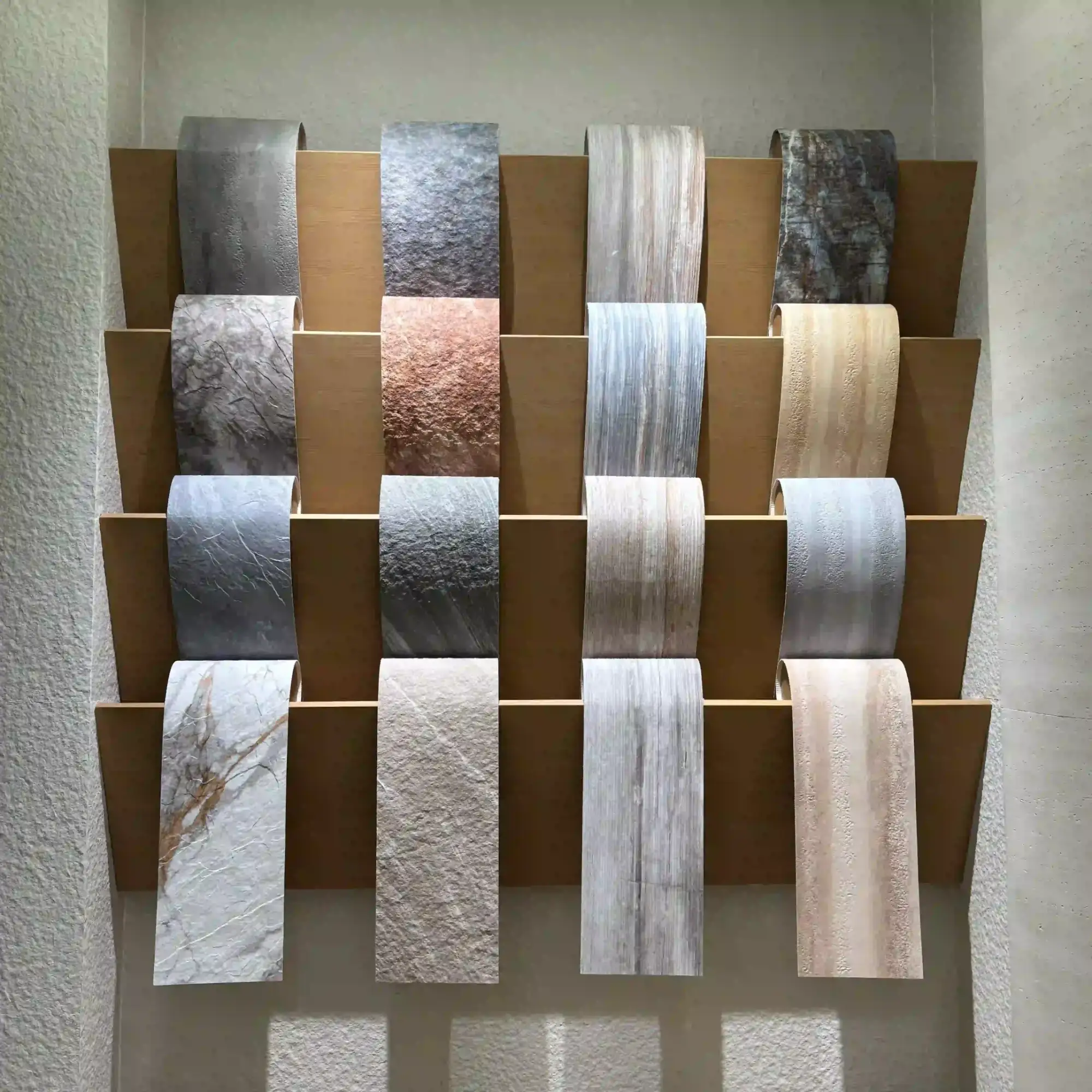
One step further is fabrication: precision cutting to size, CNC cutting, drilling and shaping, edge treatment and polishing, customized surface finishes, waterjet and project-specific processing, component and finished-product manufacturing, and customization to drawings and project specifications. These capabilities sit in the fabrication stage of the manufacturing bases, and they decide whether the customer receives a rolled sample or a finished piece ready to go on the wall.
IV. Where a Washbasin Drawing Goes After It Is Handed Over
From buyers "bringing orders to find products" to overseas clients "bringing drawings to find materials," a sheet of paper handed across the table is half the trust already given. At this edition, a hotel project client came to the stand with a drawing for a quartz washbasin. What they wanted was not a price per square metre, but a fabrication plan and an all-in quotation. Buyers used to ask most about price and lead time. Now they ask most about certification, custom fabrication and project support.
Our response changed with them. Quoting moved from "material cost per square metre" to a comprehensive proposal that accounts for fabrication processes, material waste and delivery cycle. We put together a project support team of foreign-language project managers, CAD detailing designers and application engineers, covering design development, AI-assisted slab nesting and on-site installation guidance. A comprehensive proposal is not a different formula; it opens up three costs that used to stay hidden inside the factory — processing, waste and cycle time — and all three have to come from measured line data and nesting results, not a sales estimate.
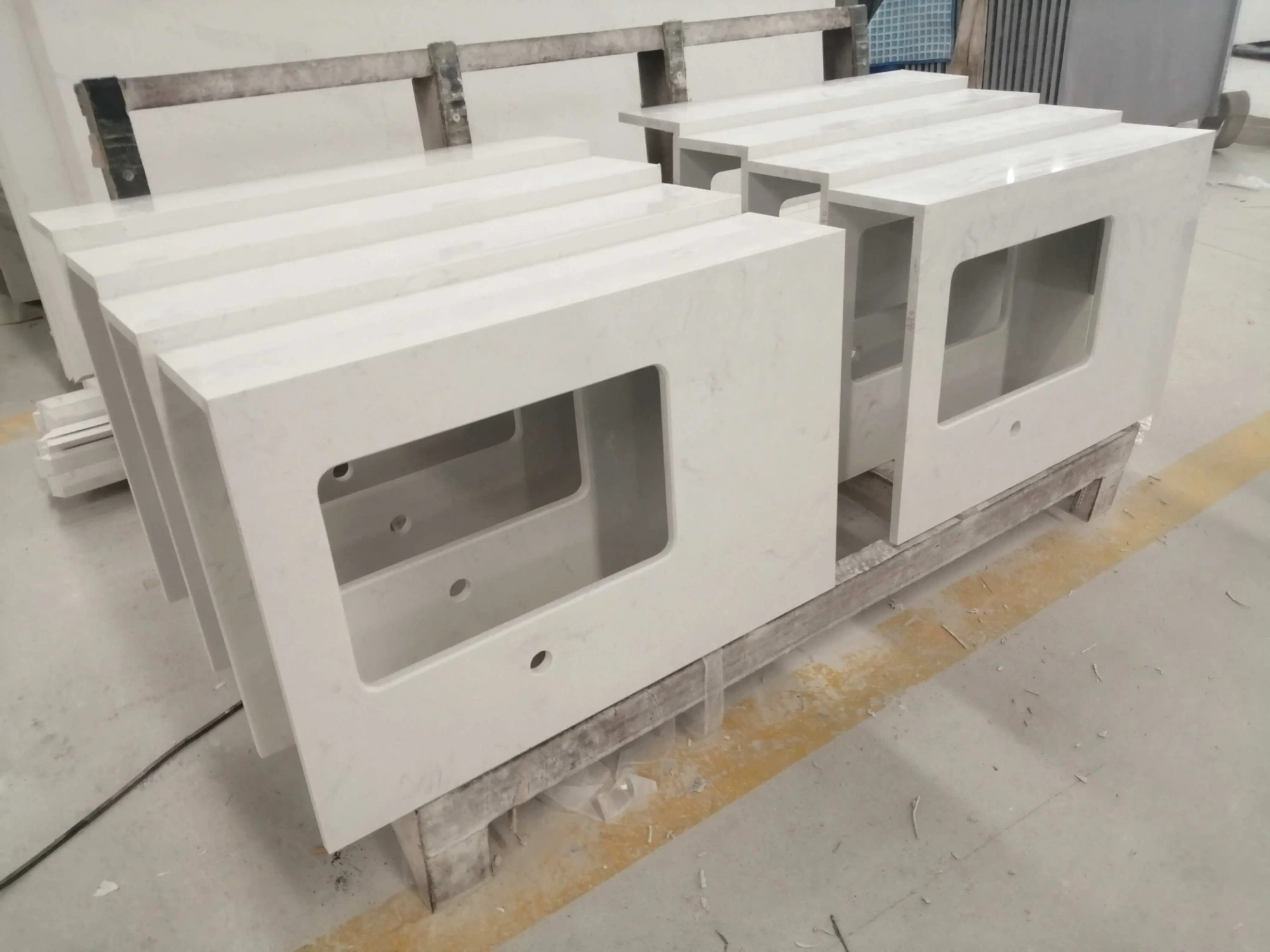
A drawing comes in and travels this chain:
At the Foshan showroom and marketing center, samples are seen, materials selected and solutions discussed — quartz, zero-silica quartz, inorganic terrazzo, flexible stone, natural marble, engineered stone and sintered stone under one roof, so a client does not have to visit seven suppliers for a single washbasin. Next comes CAD detailing and prototyping, turning the drawing into a nestable layout. The Yunfu manufacturing base optimizes the layout and cuts to size, working out how to cut the slab with the least waste and the smoothest installation, then schedules production by formulation, thickness and batch. The Heyuan base takes on scaled delivery, with quality control from raw material all the way to packing. Finally, logistics and installation guidance close the loop.
One showroom, two manufacturing bases, one chain that never changes hands — that is what a one-stop project inquiry looks like when it actually works. From "selling slabs" to "selling the ability to deliver," with trade protectionism rising and exchange rates and ocean freight swinging hard, the scarcest thing anyone can deliver is certainty. We cannot change exchange rates or freight rates. We can change the part that belongs to us: pulling tolerances, waste and lead times inside our own factories.
V. From Exporting Products to Exporting a Brand
Twenty uninterrupted years at the Canton Fair have shifted in meaning from "winning orders" at the start to "building a brand, opening markets and connecting resources." In its 70 years the Fair has moved four times and never skipped an edition; it began with 13 state-owned specialized foreign-trade corporations and now brings together manufacturers, private companies and foreign-invested enterprises; it has grown from "selling to the world" to "buying from and selling to the world." "Without the Canton Fair, Yunfu's stone companies would still have grown, but reaching international markets, building a global client network and establishing brand influence might have taken much longer."
We are one exhibitor in the Yunfu delegation. The platform offers the chance to be seen — no more, no less. Showing up at every edition, setting the stand properly, putting new materials on it: that is all. What catches the opportunity is not on the stand. It is on the production line.
Those twenty years in step are the synchronized movement of booth, edition count, clientele and the questions they ask. The forty years out of step are every reformulated batch, every added machine, every thicker quality-control checklist since 1982. The latter has no edition number, no photograph, and follows no exhibition calendar.
Exporting a brand, in the end, is not hanging a sign outside. It is having the word "Yunfu" checked and approved again and again — on a client's drawings, in test reports, on acceptance sheets. "We hope to become a representative brand for Yunfu stone at the Canton Fair, and help Yunfu stone move from exporting products to exporting a brand."
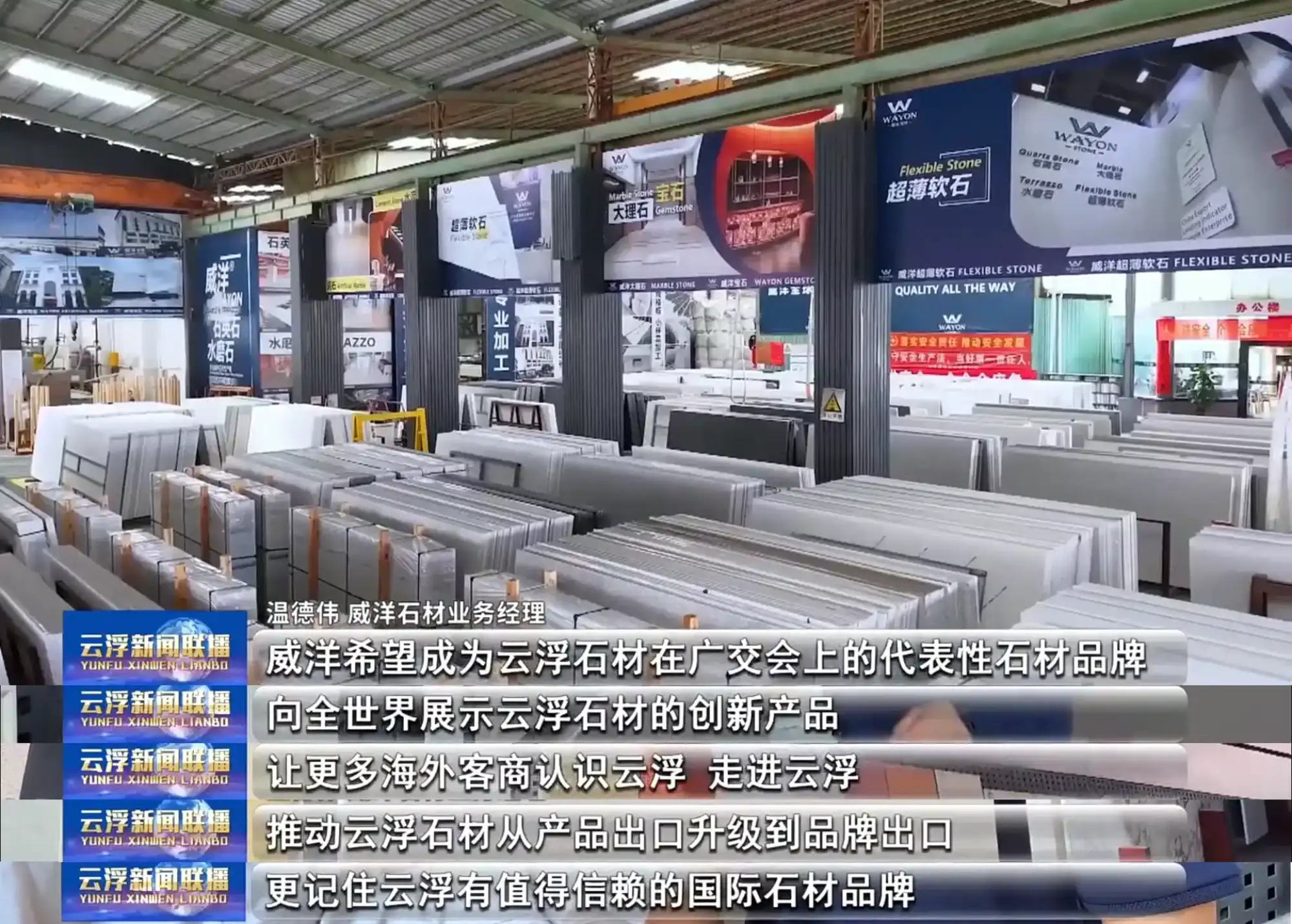
The Yunfu Daily report ends with this line:
"Let the world not only know that Yunfu has good stone, but remember that Yunfu has an international stone brand worth trusting."
That trust is not only on the stand. It is in the pressing lines at the Yunfu base, in the ±1°C control on the flexible-stone line, in that stack of XRD and SGS reports behind "below 1%," in layout drawings revised over and over, and in the space at the Foshan showroom where you can sit with a washbasin drawing and talk for a whole day.