

Engineered Quartz Countertops: The Complete Guide to Selection, Quality, and Sourcing
Engineered quartz countertops have become the most specified surface material in kitchens, bathrooms, and commercial spaces across North America, Europe, and Australia. According to industry data, quartz now accounts for a larger share of the countertop market than granite, marble, and solid surfaces combined in many developed markets.
But for wholesale distributors, contractors, and project specifiers who source quartz countertops at scale, the question is not whether to choose quartz. It is how to choose the right supplier. This guide will cover material science, manufacturing quality markers, the regulatory shift toward silica-free formulations, and the criteria that separate world-class quartz manufacturers from the rest.
What Separates Premium Quartz from Commodity Quartz
Not all engineered quartz is created equal. Two slabs that look identical in a showroom can perform completely differently in fabrication and over the years of use. Here is what separates premium products from the rest.
Resin Quality
The resin binder makes up only 7 to 10 percent of a quartz slab by weight, but it determines most of the slab’s long-term performance. Premium manufacturers use high-grade polyester or acrylic resins from established chemical suppliers. These resins resist yellowing under UV exposure, maintain flexibility to prevent micro-cracking, and bond uniformly with the quartz particles.
If the materials are used with lower-grade resins, slabs that yellow within a year in sunlit kitchens, develop hairline cracks around cutouts, or lose gloss in high-traffic areas. These problems will show up six to twelve months after installation.
Ask your supplier who manufactures their resin.
Quartz Purity and Particle Grading
High-quality engineered stone uses carefully graded quartz particles — sorted by size and blended in precise ratios to achieve maximum packing density. This is what gives premium quartz its tight, non-porous surface.
Impurities in the raw quartz — iron oxides, clay, and organic matter — can cause color inconsistency, reduced hardness, and unpredictable staining behavior. The particle size distribution may be inconsistent, leaving microscopic voids that compromise stain resistance.
The difference is invisible to the naked eye on a small sample. It becomes obvious when you cut into a full slab and find uneven density or unexpected chipping at the edges.
Pigment System
The difference between a premium pigment system and a budget one comes down to three things:
Source quality. Premium manufacturers use pigments from established international suppliers (BASF, Clariant, Ferro). These pigments are manufactured to tight tolerances in particle size and chemical composition, ensuring consistent color reproduction from batch to batch.
Dispersion technology. Pigments must be uniformly dispersed throughout the resin-quartz mixture. Poor dispersion creates micro-variations in color that become visible across large surfaces — a problem that never shows up on a 100mm sample.
Through-body consistency. In premium quartz, color extends through the full thickness of the slab. In budget quartz, color may be concentrated near the surface, with a lighter or different-colored core. This becomes visible when the slab is cut, mitered, or edge-profiled.
Compression Technology
The vacuum vibro-compression process is the heart of quartz manufacturing. The vacuum removes air from the mixture, and high-frequency vibration settles the quartz particles into the densest possible arrangement. The quality of this process determines the slab's porosity, strength, and surface integrity.
Premium manufacturers use computer-controlled presses that maintain precise vacuum levels (typically below 10 mbar) and vibration parameters throughout the compression cycle. The result is a slab with near-zero porosity — water absorption below 0.02 percent — and uniform density from edge to edge.
Budget manufacturers often use older presses with less precise control. The result can be uneven density — denser in the center, slightly porous at the edges — that leads to differential polishing, edge chipping during fabrication, and inconsistent stain resistance across a single slab.
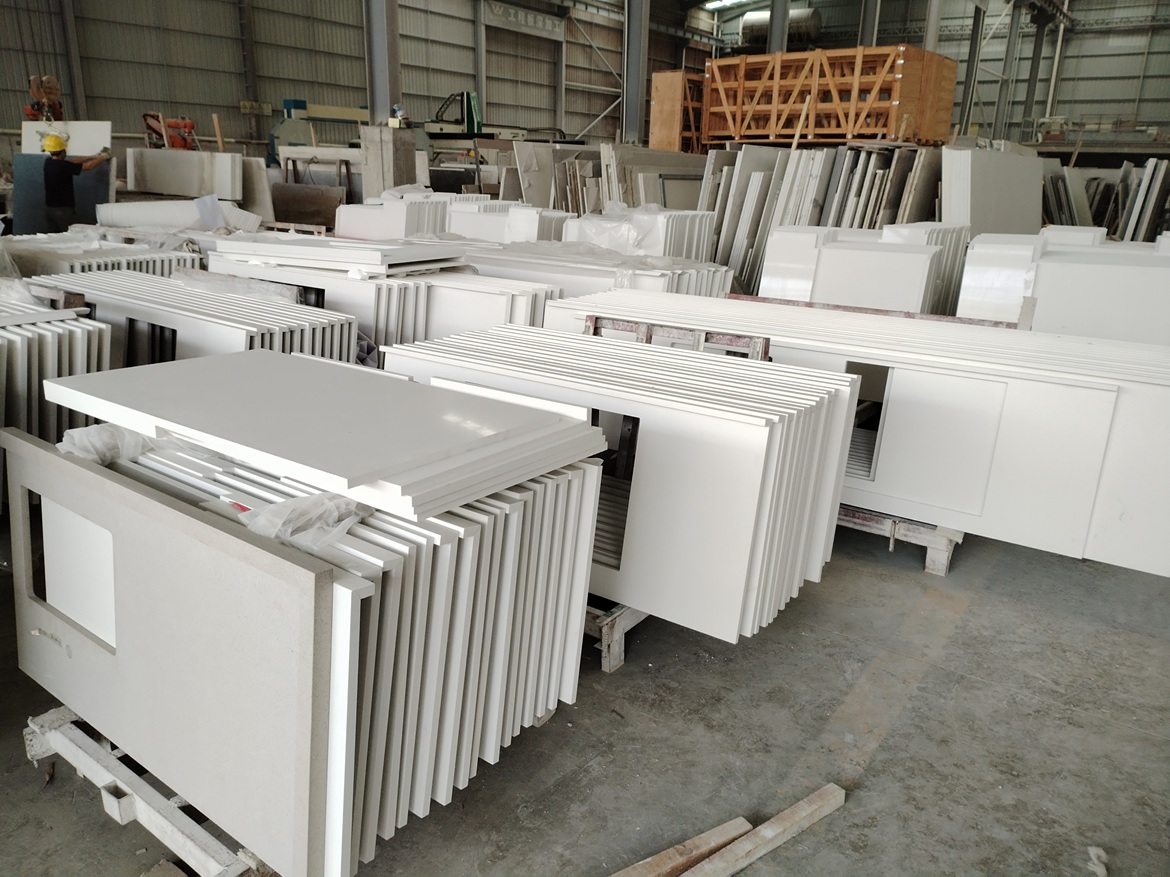
5-Point Quality Checklist for Bulk Buyers
When you are evaluating a quartz supplier for a wholesale or project order, here are the five things to check that samples alone cannot tell you.
1. Check the Cross-Section
Ask for a cut sample — a piece that shows the full thickness of the slab, not just the polished surface. Look at the edge:
Is the color consistent from surface to surface? If the core is a different color, the slab uses surface-level pigmentation. This is fine for standard countertops, but problematic for waterfall edges, mitered joints, and any installation where the slab edge is exposed.
Is the density uniform? Uneven density shows as visible layers or bands in the cross-section.
Are there air pockets? Tiny bubbles visible in the cross-section indicate incomplete vacuum compression.
2. Inspect the Backing Mesh
The backing mesh — the fiberglass or polymer layer applied to the back of the slab — tells you a lot about a manufacturer's quality standards.
Premium manufacturers apply a clean, uniform backing that fully covers the slab surface. The mesh is properly embedded and does not peel away easily. Budget manufacturers may apply a thin, uneven backing that delaminates during fabrication or even during shipping.
A delaminated backing mesh is not just a cosmetic issue. It can cause the slab to flex unevenly during installation, leading to cracks around cutouts or along seams.
3. Demand Delta E Data
Color consistency between batches is the single most common complaint in the quartz wholesale business. A distributor receives a new container, opens the crates, and the color does not quite match the previous shipment. The result: returns, rework, and unhappy customers.
Delta E is the standard measurement of color difference between two samples. A Delta E value below 1.0 is considered imperceptible to the human eye. Values between 1.0 and 2.0 are acceptable for most applications. Values above 2.0 mean visible color variation.
When evaluating a supplier, ask for Delta E data across multiple production batches. A manufacturer that tracks and shares this data has the quality control systems in place to deliver consistent product. A manufacturer that cannot provide Delta E data is asking you to trust them on faith.
4. Verify Thickness Tolerance
Quartz slabs are specified at a nominal thickness — typically 20mm or 30mm. But actual thickness can vary by 1mm, 2mm, or even more from slab to slab, or across a single slab.
Thickness variation causes real problems in fabrication. Seams between slabs with different thicknesses require extra grinding to level. Undermount sinks may not fit properly. Backsplashes may not align.
Premium manufacturers hold thickness tolerance to ±0.5mm. Ask your supplier for their thickness tolerance specification and verify it when the shipment arrives. A simple caliper check on arrival can save weeks of fabrication headaches.
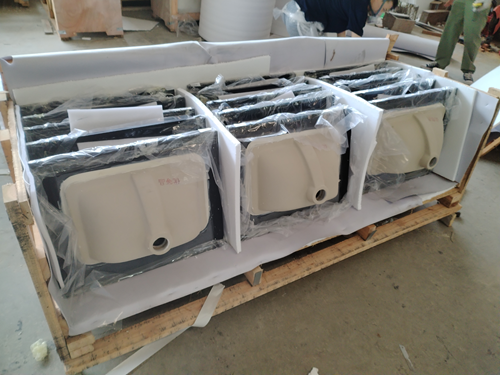
5. Inspect the Packaging
For international shipments, packaging quality is the difference between slabs arriving in perfect condition and slabs arriving cracked, chipped, or scratched.
Premium export packaging includes:
- Individual slab wrapping with protective film
- Corner protectors on all four corners
- Vertical crating with proper bracing to prevent slab movement during transit
- Moisture barrier for container shipping
- Clear labeling with slab dimensions, color code, and batch number
If a manufacturer cuts corners on packaging, they are telling you something about their overall quality philosophy. Ask for photos of their standard export packaging before placing an order.
How to Evaluate a Quartz Manufacturer
Visiting a factory is the gold standard for evaluating a supplier, but not every buyer has the time or budget for a site visit. Here is what to look for — whether you are visiting in person or evaluating from a distance.
What to Look for on a Factory Visit
If you visit a quartz stone manufacturer, both the showroom and the production floor deliver critical insights for a comprehensive quality evaluation. Here are the key checkpoints across each area:
The Showroom
The showroom reflects a manufacturer’s product maturity and service capabilities directly. Focus on these details:
- Full product portfolio: Review the full range of patterns, surface finishes, slab sizes and thickness options to confirm the supplier can support diverse project and distributor needs.
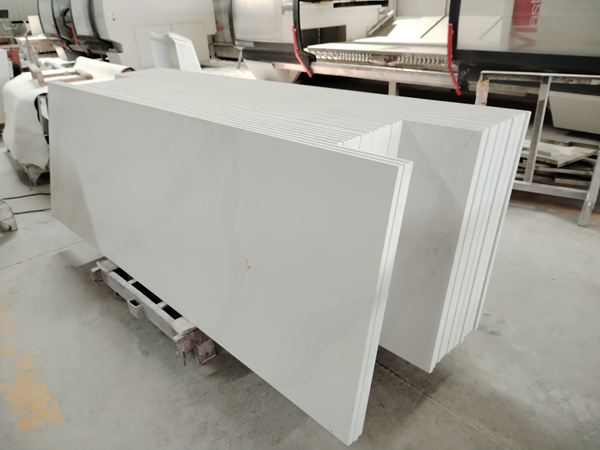
- Full-slab consistency: Examine multiple full slabs of the same pattern to assess veining continuity and batch-to-batch color uniformity — a detail that small sample pieces cannot fully demonstrate.
- Fabrication craftsmanship: Inspect finished samples of edge profiling, mitered joints, book-matched panels and waterfall island details to evaluate custom fabrication capacity.
- Compliance credentials: Verify original copies of international certifications (ISO 9001, CE, NSF, Greenguard Gold) and real project case studies to confirm export qualification and large-scale project experience.
- Custom solution capability: Check examples of custom patterns, special slab dimensions and private labeling samples to assess the supplier’s flexibility for tailored requirements.
Raw Material Storage
Are quartz and resin stored properly? Raw quartz should be covered to prevent contamination. Resin drums should be stored at controlled temperatures. Disorganized raw material storage is a sign of poor process control.
The Mixing Area
Look at the precision of the batching system. Automated batching with digital scales is standard at quality manufacturers. Manual batching with shovels is a red flag.
The Press Room
Check the age and condition of the vacuum vibro-compression presses. Well-maintained presses from established manufacturers (Breton, for example) produce better slabs than older, poorly maintained equipment.
The Curing Area
Temperature and humidity control during curing directly affects slab quality. A professional curing area will have temperature monitoring and controlled airflow.
The Quality Control Station
This is the most critical stop on the production floor. How many slabs are inspected? What tests are performed? Are results recorded and traceable to individual slabs? A manufacturer with a proper QC station will have data sheets, test equipment (hardness testers, gloss meters, color spectrophotometers), and a clear process for rejecting non-conforming slabs.
The Scrap Pile
Look at rejected slabs. What defects are common? A manufacturer that is honest about their defect rate and has a clear process for handling rejects is more trustworthy than one that claims zero defects.
10 Questions to Ask Every Supplier
If you cannot visit in person, ask these questions in your initial communication:
- What is your annual production capacity (in square meters)?
- What is your current yield rate (percentage of slabs that pass QC)?
- Who supplies your resin and pigments?
- What type of vacuum vibro-compression press do you use?
- What is your thickness tolerance?
- Can you provide Delta E data across multiple production batches?
- What certifications do you hold (ISO 9001, CE, NSF, Greenguard)?
- What is your standard export packaging specification?
- What is your typical lead time from order confirmation to shipment?
- What is your process for handling quality complaints?
A supplier that answers these questions clearly and provides documentation earns trust. A supplier that is vague or evasive is asking you to take a risk.
Red Flags to Watch For
The sample is noticeably better than the production slabs. This is the most common complaint in the industry. Protect yourself by requesting random production samples — not specially prepared samples — for evaluation.
The supplier cannot or will not provide third-party test reports. In-house test results are better than nothing, but third-party verification is the standard for export-grade quartz.
Lead times keep slipping. A pattern of missed delivery dates suggests production or capacity issues that will only get worse as your order volume grows.
The price is significantly below market average. There is a reason. Cheap quartz is cheap for a reason — lower-grade materials, less precise manufacturing, thinner slabs, or weaker packaging. The savings disappear when you start dealing with returns and complaints.
Product Specifications Reference
|
Parameter |
Premium Standard |
Acceptable Range |
|
Quartz Content |
~93% |
90-93% |
|
Resin Content |
~7% |
7-10% |
|
Mohs Hardness |
7 |
6-7 |
|
Water Absorption |
< 0.02% |
< 0.05% |
|
Flexural Strength |
≥ 45 MPa |
≥ 40 MPa |
|
Thickness Tolerance |
±0.5mm |
±1.0mm |
|
Delta E (batch-to-batch) |
< 1.0 |
< 2.0 |
|
Standard Sizes |
3000×1400mm, 3200×1600mm |
Varies by manufacturer |
|
Thickness Options |
15mm, 20mm, 30mm |
12mm-30mm |
Frequently Asked Questions
How do I verify that the sample matches production quality?
Request random production samples, not specially prepared showroom samples. Ask for photos of multiple slabs from the same production batch. For critical orders, consider hiring a third-party inspection company to verify quality at the factory before shipment.
What should I do if a shipment has visible color variation?
First, determine whether the variation exceeds the Delta E threshold specified in your contract. If it does, document the issue with photos and contact the supplier immediately. Most reputable manufacturers will offer replacement slabs or a credit for non-conforming product. If your contract does not specify color tolerance, negotiation becomes more difficult — which is why you should always include Delta E requirements in your purchase agreement.
What is a reasonable minimum order quantity for first-time buyers?
Most manufacturers require 100 to 300 square meters for first orders — roughly one 20-foot container. Some suppliers offer smaller trial orders at a premium. If you are testing a new supplier, consider starting with a partial container of popular colors that can be sold quickly even if you decide not to continue the relationship.
How long does it take from order to delivery?
Standard production lead time is 15 to 20 working days from order confirmation. Ocean freight from China to North America takes approximately 25 to 35 days, depending on the port. Total lead time from order to arrival is typically 45 to 60 days. Express production can reduce the factory lead time to 7 to 10 days for urgent orders, subject to capacity.
What is the best way to handle quality complaints with an overseas supplier?
Document everything with photos and written descriptions. Most reputable suppliers have a formal claims process. For significant quality issues, consider involving a third-party inspection company to provide an independent assessment. Maintain professional communication — suppliers are more responsive to buyers they want to keep as long-term customers.
How do I know if a manufacturer is being honest about their certifications?
Certification numbers can be verified with the issuing body. ISO 9001 certificates can be checked on the IAS or ANAB databases. NSF and Greenguard certifications are listed on the respective organization's websites. If a supplier claims certifications but cannot provide certificate numbers or issuing body details, treat the claim with skepticism.
Can I get custom slab sizes for large projects?
Many manufacturers offer custom dimensions for large-volume orders. The minimum for custom sizes is typically 500 to 1,000 square meters. Custom sizes may require longer lead times and carry a small premium. For standard projects, stock sizes (3000×1400mm or 3200×1600mm) are more cost-effective.
What is the typical defect rate for export-grade quartz?
A well-managed factory maintains a defect rate below 3 to 5 percent. Defects include surface pinholes, micro-cracks, color variation, thickness variation, and edge chips. Manufacturers with higher defect rates either have weaker quality control or are selling lower-grade material. Always ask about yield rate during supplier evaluation.