

How Prefabricated Stone Supports Modular Construction: Applications, Benefits & Future Trends
Construction is becoming increasingly industrialized, with more cutting, assembly, and quality control moving from jobsites into factories. This shift is also changing how architectural stone is specified and delivered. Instead of shipping raw slabs for local processing, project teams can procure prefabricated stone and finished stone products manufactured from confirmed drawings. Meanwhile, flexible stone offers a lightweight surface solution for modular units, curved structures, and fast-build spaces. Together, these approaches help stone materials fit more efficiently into modern modular construction workflows.
Quick Answer: What Is Prefabricated Stone?
Prefabricated stone refers to natural or engineered stone products that are processed, cut, finished, or assembled in a factory according to project requirements before delivery. Unlike traditional slab supply, prefabricated stone transfers more fabrication work from the jobsite to a controlled manufacturing environment.
Why Construction Is Moving Toward Prefabrication and Modular Assembly
Prefabrication changes more than the location of production. It reshapes how buildings are designed, how materials are specified, and how contractors coordinate installation.
Moving Work from the Jobsite to a Controlled Factory
Traditional stone installation often involves several activities at the project site, including measurement, cutting, drilling, edge finishing, trial fitting, and adjustment. The quality and speed of this work can be affected by available equipment, workspace limitations, dust-control requirements, weather, and the experience of local labor.
Moving these processes into a controlled factory makes production easier to standardize. Manufacturers can use specialized equipment, inspect components at defined production stages, and check dimensions before the products are packed. For projects with repeated rooms or architectural elements, factory production also supports consistent specifications across large quantities.
Responding to Labor Shortages and Tighter Project Schedules
Hotel, apartment, retail, and commercial projects increasingly face demanding delivery schedules. At the same time, qualified stone fabricators may not be readily available near every project site, particularly for large international developments or temporary structures built in remote locations.
Prefabricated components reduce the amount of specialist processing required after delivery. When pieces arrive accurately fabricated and clearly identified, installation teams can concentrate on positioning, joining, and fixing them according to the approved method.
DfMA Is Changing How Building Materials Are Specified
Design for Manufacture and Assembly, or DfMA, considers how a component will be produced, transported, handled, and installed from the beginning of the design process. Materials are evaluated not only by appearance and performance, but also by their suitability for repeatable manufacturing and efficient assembly.
For modular stone construction, this means resolving dimensions, joints, openings, weight, tolerances, and installation interfaces earlier. The result is a more coordinated form of engineered stone solution that supports both factory production and site execution.
What Does Prefabricated Stone Mean in Modern Construction?
Prefabricated stone means natural or engineered stone processed in a factory according to project-specific requirements and delivered as cut-to-size or installation-ready components.
Prefabricated Stone vs. Raw Slabs and Standard Tiles
Raw slabs represent an early stage in the stone supply chain. They still require local templating, cutting, edge processing, drilling, and finishing before installation. Standard tiles reduce some of this work, but they may not accommodate project-specific dimensions, joints, openings, or architectural details.
Prefabricated stone goes further. Depending on the application, the factory can complete precision cutting, edge profiles, holes, grooves, surface finishing, bonding, assembly, and identification. Prefabricated stone panels and other finished components can then be delivered in the sizes and configurations required by the approved drawings.
The appropriate level of completion varies. A countertop may arrive with sink and faucet openings, while a modular column may be divided into numbered sections with coordinated seams and fixing points. The objective is to transfer as much predictable work as practical from the site to the factory.
Prefabricated Stone vs. Precast Stone
Prefabricated stone and precast stone are not necessarily the same. Precast stone commonly refers to a product formed by casting a cementitious or similar mixture in a mold. Its shape is created during the casting process.
Prefabricated stone is a broader delivery concept. It can include fabricated marble, granite, quartz stone, terrazzo, and other architectural stone materials. A product may be cut from a slab, formed, bonded, or assembled into a finished component before shipment without being a precast product.
Two Stone Solutions for Off-Site and Modular Construction
Stone for modular construction generally follows two complementary paths: factory-finished components for precise functional areas and lightweight, flexible surfaces for adaptable architectural finishes.
Finished stone products transfer detailed fabrication and partial assembly into the factory. They are suitable for applications that require accurate openings, completed edges, durable working surfaces, or coordinated component systems.
Flexible stone responds to a different set of requirements. Its thin, lightweight, and bendable form makes it suitable for light structures, curved surfaces, mobile spaces, and modules where conventional stone thickness and weight would be difficult to accommodate. The two solutions can be used separately or combined within one project.
Finished Stone Products That Reduce On-Site Fabrication
Finished stone products are manufactured for a defined project condition rather than supplied only as general-purpose slabs. Their success depends on accurate drawings, coordinated details, and a clear understanding of the installation method.
Integrated Quartz Vanity Basins and Bathroom Components
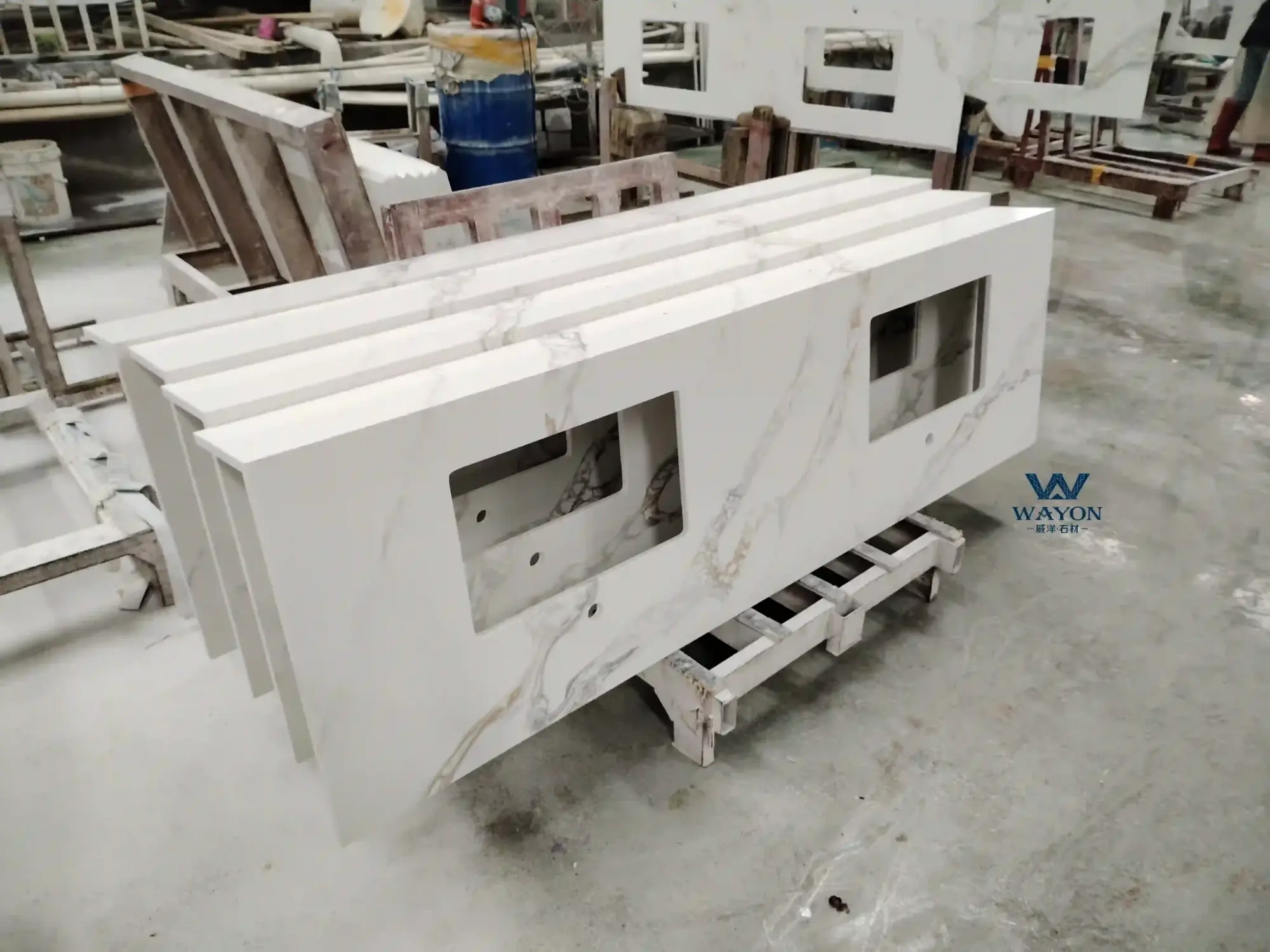
Integrated quartz vanity basins can combine the countertop, basin, backsplash, and related details into a coordinated bathroom component. Sink openings, faucet holes, edge profiles, drainage slopes, and connection positions can be processed or assembled before delivery, subject to the approved design.
These products are particularly relevant to hotels, apartment developments, and prefabricated bathroom pods with repeated room layouts. Factory fabrication supports repeatable dimensions and consistent finishes across multiple units, while reducing cutting, polishing, and wet work at the project site.
Completed components can also simplify room-by-room installation. Each vanity may be numbered according to its building, floor, room, or module, allowing contractors to connect the delivered product with the project schedule.
Modular Marble Columns and Architectural Features
Decorative marble columns can be divided into transportable modules instead of being delivered as oversized or unfinished pieces. Column covers, bases, capitals, wall features, and other architectural elements can be fabricated according to the required geometry and installation conditions.
The division of each element must be planned carefully. Joint positions should support the visual design while remaining practical for manufacturing, packing, handling, and fixing. Complex components may be trial assembled in the factory so that matching parts, pattern alignment, seams, and key dimensions can be checked before shipment.
A coordinated numbering system is especially important for natural marble because adjacent pieces may need to follow a specific sequence. Clear shop drawings and installation references help preserve the intended appearance during site assembly.
Interlocking and Modular Stone Furniture
Stone furniture can also be designed as a collection of accurately fabricated parts. Tabletops, bases, shelves, panels, and decorative surfaces may use interlocking or concealed connection details that allow the product to be transported in manageable sections and assembled at its destination.
This approach is useful for hospitality interiors, retail environments, reception areas, and repeated furniture packages. Once a design has been prototyped and approved, the factory can reproduce its critical dimensions across multiple pieces.
Modular design can improve packing efficiency and make large products easier to move through lifts, corridors, and doorways. The connection structure must still account for stone weight, load distribution, stability, and safe installation.
Other Installation-Ready Stone Components
Custom stone fabrication can support countertops, vanity tops, stair treads and risers, wall and floor pieces, reception desks, furniture tops, decorative profiles, and coordinated bathroom or kitchen packages. The products may be supplied individually or organized into sets for particular rooms and installation zones.
The essential distinction is that these pieces are produced for their final application. Their dimensions, edges, openings, surface finish, component relationships, and packaging are determined by project information rather than left for local fabricators to resolve.
How Custom Stone Fabrication Works from Drawings to Delivery
Effective custom stone fabrication is a coordinated engineering process. It turns approved design information into traceable components that can be transported and installed in the intended sequence.
Drawing Review and Design Coordination
Production normally begins with shop drawings, CAD files, schedules, or other technical documents. These should define final dimensions, tolerances, edge profiles, openings, joint locations, material direction, surface finish, and installation interfaces.
The project team and manufacturer must also establish responsibility for site measurements. If factory production is based on architectural dimensions before the supporting structure is completed, appropriate tolerances and adjustment methods must be designed into the system. Incomplete or changing information increases the likelihood of fit problems after delivery.
During drawing review, complex components may be divided into smaller modules to meet manufacturing, loading, container, lifting, and installation requirements. Decisions made at this stage affect the entire delivery process.
Material Selection, Prototyping and Pre-Assembly
Material samples allow the architect or client to review color, texture, finish, and general appearance before production. Natural stone may require an additional review of veining, tonal variation, and book-matching expectations. Engineered materials require confirmation of the selected design and production batch strategy.
For custom basins, furniture, columns, and unfamiliar installation details, a prototype or mock-up can verify proportions and assembly logic. A first-piece inspection provides another opportunity to check dimensions, edges, holes, joints, and finish quality before the remaining quantity enters production.
Complex components may also be pre-assembled temporarily. This does not eliminate the need for correct site installation, but it helps identify mismatched pieces or unresolved interfaces while the products are still in the factory.
Production, Identification and Quality Control
During production, fabrication data should remain linked to the approved drawings and component schedule. Dimensional inspections, finish checks, color management, and part matching can be completed at appropriate stages rather than only after all pieces are finished.
Identification codes connect each physical component with its drawing reference and installation location. For repeated bathrooms or furniture sets, this may include the building, floor, room, product type, and part number. More complex architectural features may also require diagrams showing the correct assembly sequence.
Packaging Around the Installation Sequence
Packaging must protect finished edges and surfaces during lifting, international transportation, unloading, and site storage. It should also support the contractor’s installation plan.
Components can be grouped by room, floor, elevation, module, or installation phase. Packing lists and external crate labels should make the contents easy to identify without repeatedly opening packages. When practical, the first products required on site should remain accessible, preventing unnecessary handling and reducing the risk of damage.
Flexible Stone for Lightweight and Adaptable Construction
Flexible stone extends stone-inspired finishes to substrates and structures that may not accommodate conventional slabs. Its value comes from the relationship between appearance, weight, flexibility, and installation.
Why Flexible Stone Fits Modular Building Systems
Modular units must be manufactured, lifted, transported, and joined at the destination. Every finish contributes to the weight of the completed module, so material thickness and handling requirements can influence structural and logistical planning.
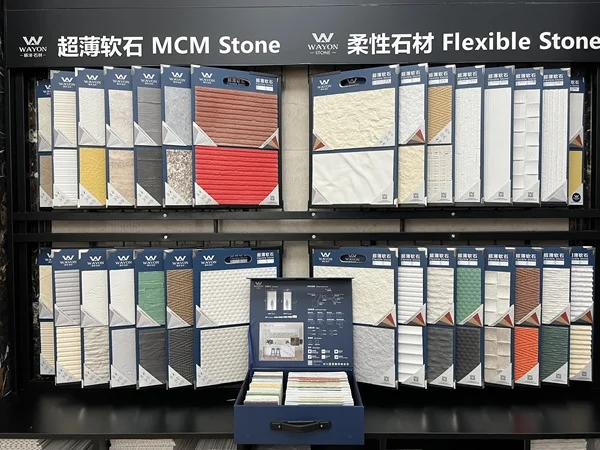
Flexible stone is thin and comparatively lightweight, making it easier to carry and apply to suitable wall panels, partitions, furniture surfaces, and prefabricated modules. It can provide a stone appearance while placing less load on the structure than conventional thick stone pieces.
Its flexibility also allows it to follow certain curved and irregular surfaces. This expands the range of shapes that can be finished without cutting numerous narrow stone pieces or designing heavy curved components.
Flexible Stone Panels for Interior and Exterior Surfaces
Flexible stone panels can be considered for interior walls, columns, ceilings, reception areas, furniture finishes, and modular room surfaces. Depending on the tested product system, they may also be used on exterior walls and other exposed architectural areas.
Exterior suitability must be evaluated for the actual project rather than assumed from the product category alone. The project team should confirm weather resistance, water management, fire requirements, dimensional stability, substrate compatibility, adhesive selection, joint treatment, edge protection, and local building regulations.
Installation quality remains important despite the material’s lower weight. The substrate should be stable, clean, and properly prepared, while the adhesive and finishing details should follow the manufacturer’s recommendations for the selected environment.
Flexible Stone for Curved and Complex Modules
Curved walls, round columns, reception counters, furniture bodies, and sculpted display structures can be difficult to finish with rigid stone. Flexible stone can conform to an approved radius and create a more continuous surface with fewer individual rigid pieces.
This makes it useful for modular interiors and branded environments where lightweight construction is combined with complex geometry. Designers should confirm the minimum bending radius, panel direction, joint arrangement, corner treatment, and installation procedure through samples or mock-ups before approving the final design.
Where Prefabricated and Flexible Stone Can Be Used
The correct solution depends on the component’s function, weight limit, geometry, durability requirements, installation method, and desired appearance. Many projects benefit from using both material formats.
Modular Hotels, Apartments and Prefabricated Bathrooms
Hotels and apartments contain repeated room types, making them well suited to factory-produced components. Integrated quartz basins, vanity tops, countertops, and bathroom parts can be manufactured to repeatable specifications and assigned to specific modules. This approach is widely applied in modular hotel construction.
Finished stone products are appropriate where the surface needs accurate openings, completed edges, abrasion resistance, or a substantial stone form. Flexible stone panels can complement them on lightweight partitions, feature walls, curved surfaces, and other decorative areas where reducing module weight is a priority.
RVs, Camping Units and Mobile Buildings
RVs, camping cabins, and mobile buildings must control weight because completed units are transported and may remain subject to movement during use. Conventional stone slabs may add more structural and transport load than the design can accept.
Flexible stone and other lightweight stone panels can provide a mineral or stone appearance on suitable interior and exterior surfaces, subject to system testing and application requirements. Small finished countertops or functional stone components may still be used where adequate support and fixing are available.
Fast-Build Retail, Hospitality and Exhibition Spaces
Retail stores, restaurants, showrooms, and exhibition stands often operate under short fit-out schedules. Factory-fabricated reception desks, furniture tops, display elements, and wall components can reduce the amount of detailed processing required during installation.
Flexible stone works well with lightweight exhibition walls, curved brand features, counters, and prefabricated display modules. Panels may be applied during off-site production, allowing completed units to arrive with much of the decorative finish already installed.
Temporary Structures for Major Global Events
World Expos, international sporting events, cultural festivals, and other major gatherings require large numbers of spaces to be completed within fixed schedules. Temporary structures may also need to be dismantled, relocated, or reused after the event.
Flexible stone is suitable for consideration on weight-sensitive walls, irregular forms, and transportable modules. Finished components can be reserved for counters, washbasins, furniture, and other functional areas requiring precision or durability. Material performance, reuse plans, fire requirements, and exposure conditions should be confirmed for each venue.
Permanent Commercial and Public Buildings
Prefabricated stone is equally relevant to permanent construction. Hotels, offices, shopping centers, residential developments, and public buildings can use installation-ready countertops, columns, wall components, stairs, and furniture packages. These solutions support a wide range of commercial construction projects.
Flexible stone can support renovation surfaces, lightweight partitions, decorative ceilings, columns, and complex forms. It may be especially useful where adding the thickness or weight of conventional stone would require extensive structural changes.
Combining Finished Stone Products and Flexible Stone in One Project
The two solutions serve different parts of the same construction system. A modular hotel, for example, could use integrated quartz basins in bathroom pods, prefabricated stone furniture tops in public areas, and flexible stone panels on curved walls or lightweight partitions.
Finished stone products are generally preferable for applications requiring completed edges, precise openings, durable horizontal surfaces, structural form, or factory assembly. Flexible stone is better suited to weight-sensitive surfaces, curves, mobile structures, and fast decorative coverage. Combining them allows the specification to respond to each area instead of forcing one material format across the entire project.
Prefabricated Stone vs. Traditional On-Site Stone Fabrication
The main difference lies in where decisions and processing take place. Factory-finished delivery reduces site fabrication, but it requires project information to be coordinated earlier.
|
Decision Factor |
Traditional On-Site Fabrication |
Factory-Finished Stone |
|
Cutting and drilling |
Completed locally |
Completed before shipment |
|
Quality control |
Influenced by site conditions |
Managed in a controlled factory |
|
Skilled site labor |
More specialist labor required |
More work transferred off-site |
|
Dust and wet work |
More processing at the jobsite |
Site processing is reduced |
|
Late dimensional changes |
Local adjustment may be easier |
Requires earlier confirmation |
|
Installation sequence |
Includes fabrication and fitting |
Focuses on positioning and assembly |
|
Design coordination |
Some details may be resolved later |
Details must be resolved earlier |
|
Packaging |
Slabs or semi-finished pieces |
Component-specific organization |
Prefabrication is most effective when drawings are accurate, the design is sufficiently stable, tolerances are clearly defined, and the installation interfaces have been coordinated. Logistics must also be planned around crate dimensions, lifting equipment, site access, storage space, and installation order.
Traditional local fabrication may remain appropriate when actual dimensions cannot be confirmed until late in construction or when substantial adjustment is expected. A hybrid approach is also possible, with high-value or repeated components finished in the factory and selected final adjustments completed locally.
How to Choose a Prefabricated Stone Manufacturer
When selecting a prefabricated stone manufacturer, project teams should evaluate:
- Experience with custom stone fabrication
- Production capability for repeated components
- Ability to work from CAD drawings and shop drawings
- Quality control procedures
- Packaging and export coordination
- Support for installation planning
What Project Teams Should Confirm Before Ordering Prefabricated Stone
Early confirmation prevents the factory from producing accurate components from inaccurate or incomplete information. Before placing an order, architects, contractors, and procurement teams should review the following items:
- Final drawings, verified dimensions, and responsibility for site measurement
- Approved material, color range, surface finish, and reference samples
- Component dimensions, manufacturing tolerances, and allowable site adjustment
- Joint locations, seam widths, pattern direction, and adjacent materials
- Edge profiles, holes, grooves, drainage details, and surface treatments
- Supporting structure, fixing method, adhesives, and installation interfaces
- Interior or exterior exposure and applicable performance requirements
- Fire, weather, water, and local regulatory requirements
- Component codes, drawing references, and installation identification
- Crate size, unloading equipment, access routes, and storage conditions
- Procedure and lead time for replacement or supplementary pieces
- Delivery phases and the contractor’s planned installation sequence
Project teams should also consider the construction sequence surrounding the stone. If walls, cabinets, frames, or supporting substrates are outside their specified tolerances, a correctly manufactured component may still fail to fit. Coordination should therefore include both the stone and the conditions into which it will be installed.
How WAYON STONE Supports Prefabricated Stone Projects
WAYON STONE supports modular and prefabricated projects through material manufacturing, drawing-based custom stone fabrication, finished-product processing, and flexible stone production. This integrated approach allows different stone solutions to be coordinated around the functional and architectural requirements of a project. As a reliable stone project supplier, Wayon also provides OEM stone solutions for partners worldwide.
Based on approved information, project support can include material selection, samples, prototypes, detailed component processing, trial assembly, identification, quality inspection, and project-specific packaging. Finished stone products such as integrated quartz basins, modular marble features, countertops, and stone furniture components can be supplied alongside flexible stone panels for lightweight walls, curves, and prefabricated surfaces.
With experience in architectural stone manufacturing and global project delivery, WAYON STONE can help contractors, developers, and modular building manufacturers evaluate how much processing should be completed before shipment. To begin an assessment, project teams can provide drawings, a material schedule, application areas, quantities, installation location, performance requirements, and the expected delivery timeline.
Frequently Asked Questions
These answers address common questions about prefabricated processing, modular applications, and the coordination required before stone products enter factory production.
What Is Prefabricated Stone?
Prefabricated stone is processed in a factory according to standard or project-specific requirements before being delivered to the site. It can range from cut-to-size panels to fully finished components with edges, openings, joints, bonded parts, or assembly details already completed.
What Is the Difference Between Prefabricated Stone and Precast Stone?
Precast stone is generally formed by casting a material mixture in a mold. Prefabricated stone is a broader term covering natural and engineered stone that has been cut, finished, assembled, or otherwise prepared off-site for a specific installation.
Can Stone Products Be Manufactured Directly from Architectural Drawings?
Architectural drawings can provide the design basis, but production usually requires approved shop drawings or fabrication drawings with precise dimensions, tolerances, joints, openings, edge details, finishes, and installation interfaces. Site dimensions may also require verification before manufacturing begins.
Do Finished Stone Products Require Cutting on Site?
Accurately coordinated finished stone products can substantially reduce or eliminate planned site cutting. Minor adjustments may still be necessary if site conditions differ from the approved dimensions or if the installation system intentionally includes local trimming.
Are Flexible Stone Panels Suitable for Exterior Applications?
Some flexible stone systems can be used externally, but suitability depends on their tested performance and the complete installation system. The substrate, adhesive, joints, waterproofing, weather exposure, fire requirements, and local regulations should all be evaluated.
What Stone Products Work Best for Modular Construction?
Repeated countertops, integrated basins, bathroom components, modular columns, furniture parts, cut-to-size panels, and lightweight finishes are strong candidates. The best choice depends on weight, geometry, durability, transport, lifting, and installation requirements.
Can Flexible Stone Be Used in RVs and Mobile Buildings?
Flexible stone can be considered for RVs, camping units, and mobile buildings because it is thin and lightweight. Its suitability should still be checked against movement, vibration, temperature, moisture, substrate, adhesive, and applicable vehicle or building standards.
How Are Prefabricated Stone Components Packaged for Installation?
Components can be labeled and grouped by room, floor, elevation, module, or installation sequence. Protective crates, packing lists, component codes, and assembly diagrams help contractors identify the correct pieces while reducing unnecessary handling.
Can Finished Stone Products and Flexible Stone Be Used in the Same Project?
Yes. Finished components can serve countertops, basins, furniture, and architectural features, while flexible stone covers lightweight walls, curves, and decorative modules. Combining them allows each part of the project to use the most appropriate stone format.
Can prefabricated stone reduce construction time?
Yes. By transferring cutting, finishing, and partial assembly to a controlled factory, factory finished stone components arrive ready for positioning and fixing. This reduces on-site processing, dust work, and coordination delays, enabling faster installation sequences in modular hotel construction, prefabricated bathroom pods, and commercial construction projects. Working with an experienced prefabricated stone manufacturer that offers custom stone fabrication and OEM stone solutions further shortens overall project timelines.
Conclusion
The future of architectural stone is no longer limited to supplying slabs for local processing. Prefabricated stone allows cutting, finishing, assembly, inspection, and packaging to become part of a coordinated factory workflow, while flexible stone expands stone finishes into lightweight, curved, mobile, and fast-build structures. Successful delivery depends on more than production capability. Accurate drawings, stable dimensions, coordinated interfaces, suitable material systems, and installation-focused logistics must be resolved early. With these elements in place, finished stone products and flexible stone can support faster, cleaner, and more predictable modular construction.