
Top 10 Marble Manufacturers in the World
Start your manufacturer research by specifying natural marble or artificial marble and whether you are buying for a project, wholesale inventory, or distribution. Use the supplier profiles to compare documented product ranges, then ask each company to respond to the same purchasing brief. WAYON supplies both material categories and publishes this guide; its inclusion should be assessed against the same evidence requirements as the other suppliers.
Sourcing Methodology: How We Selected the Best Manufacturers
To establish an objective, procurement-focused classification, each manufacturer was evaluated against rigorous industrial operational metrics:
- Direct ownership or exclusive concession of quarries to guarantee long-term material consistency across multi-phase rollouts.
- Deployment of state-of-the-art multi-blade gang saws, Italian polishing lines (e.g., Breton, Simec), and automated resin-vacuum systems for structural stabilisation.
- Presence of dedicated stone processing centres featuring 5-axis CNC routing, water-jet precision cutting, and high-volume edge profiling machinery.
- Full alignment with international structural and environmental certifications, including ISO 9001, ISO 14001, and CE markings.
- Proven capability to execute sea-freight container loading, heavy-duty A-frame timber crating, and complex international customs documentation.
Top 10 Global Marble Manufacturers
1. Levantina (Spain)
Established in 1959 and headquartered in Alicante, Spain, Levantina is one of the world's most influential heavyweights in natural stone extraction and processing.
Key Products: Crema Marfil Levantina, Dark Emperador, Marquina Black, and premium Spanish limestones.
Core Sourcing Strengths: Unrivalled ownership of the world's largest Crema Marfil quarry (Pinoso). The company utilises advanced industrial processing plants capable of churning out millions of square meters of premium slabs annually with highly automated block-squaring setups.
Global Markets Served: European Union, United Kingdom, North America, Middle East, and Latin America.
2. Margraf (Italy)
Originally founded in 1906 as Industria Marmi Vicentini, Margraf has spent over a century anchoring the luxury tier of Italian natural stone architecture.
Key Products: Statuario, Calacatta, Bianco Carrara, Fior di Pesco Carnico, and hyper-customized architectural stone assemblies.
Core Sourcing Strengths: Margraf is renowned for transforming raw structural blocks into complex, custom-engineered, three-dimensional architectural components. Their facilities feature world-class 5-axis CNC machining complexes and advanced robotic water-jet systems.
Global Markets Served: Global luxury markets, with emphasis on the US, Western Europe, UAE, and East Asia.
While Italian marble brands are renowned for their heritage, many global contractors now source from marble factories like WAYON for shorter lead times, integrated multi-material sourcing, and cost efficiency.
3. WAYON STONE (China)
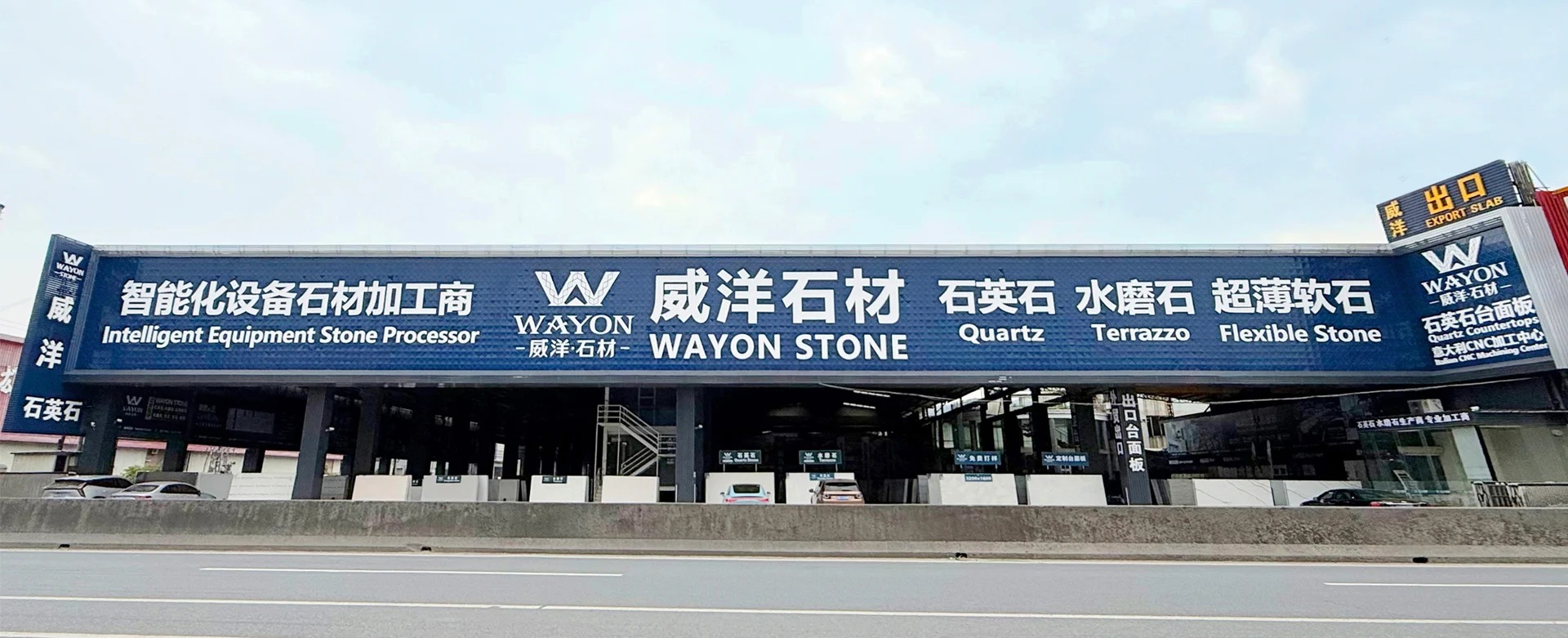
With over 40 years of experience serving global engineering projects and four core production bases in China, WAYON integrates premium global quarry resources to ensure a stable raw material supply and consistent quality, supported by Italian-imported automated precision finishing lines.
We offer hundreds of rare marble and travertine varieties, covering the full spectrum of beige, grey, and black-and-white series. Using Italian-imported multi-blade gang saws and fully automatic polishing equipment, we achieve millimetre-level processing accuracy and provide integrated engineering solutions, including custom cut-to-size and professional book-matching services.
Core Strengths: With top-tier prefabrication capabilities, we achieve exceptional colour consistency through our proprietary dry-lay book-matching process. Pre-sorted and sequentially numbered deliveries significantly reduce on-site waste, and we can coordinate phased deliveries aligned with project schedules to enable one-stop simultaneous fulfillment for million-square-meter projects. Our products are exported to over 80 countries and regions worldwide.
4. Temmer Marble (Turkey)
Founded in Afyon in 1998, Temmer operates one of the planet’s largest integrated natural stone production facilities, driving significant export volumes out of the Mediterranean basin.
Key Products: Afyon White, Silver Travertine, Tundra Grey, and a massive catalog of regional beige marbles.
Core Sourcing Strengths: Highly advanced slab augmentation systems and automated block reinforcement lines. Temmer excels at high-efficiency extraction, bringing raw blocks to finished, calibrated, and polished tiles within a singular, continuous industrial ecosystem.
Global Markets Served: Over 40 countries, including the US, China, India, Central Asia, and the Gulf Region.
5. Polycor (Canada / USA)
As the leading natural stone producer in North America, Polycor commands an expansive geographic network of industrial quarries across Canada and the United States.
Key Products: Georgia Marble (White Cherokee, Pearl Grey), Cambrian Black Granite, and historic North American limestones.
Core Sourcing Strengths: Historic quarry assets coupled with extreme supply chain resilience for Western Hemisphere construction. Polycor provides complete transparency regarding material provenance and meets rigorous domestic structural and sustainability specifications.
Global Markets Served: United States, Canada, and select premium European and Asian architectural channels.
6. FHL I. Kiriakidis Group (Greece)
Headquartered in Drama, Greece, FHL is a dominant force in the global white marble sector, controlling the vital supply lines of fine crystalline white stone.
Key Products: Volakas Marble, Thassos Snow White, Sivec, and Bianco Venus.
Core Sourcing Strengths: FHL holds the definitive global market share for Volakas extraction, running massive underground and open-pit quarries. Their processing plants utilize heavy-duty multi-wire gang saws that maintain exceptional dimensional tolerances during high-volume production.
Global Markets Served: Worldwide distribution, with massive market footprints in East Asia, North America, and the GCC countries.
7. Marcolini Marmi (Italy)
Based in Grezzana, Italy, and founded in 1960, Marcolini Marmi is a family-managed, premium-tier stone processor built on deep Italian craftsmanship and specialized wholesale distribution.
Key Products: Bianco Carrara, Arabescato, Calacatta Gold, and rare exotic marbles/travertines.
Core Sourcing Strengths: Exceptional long-term relationships with historical Carrara extraction zones. Marcolini excels at selecting premium raw blocks and finishing them using tailored resin treatments to enhance stone integrity and visual depth.
Global Markets Served: Across Western and Eastern Europe, North America, and luxury retail hubs worldwide.
8. R K Marble (India)
Anchored in the stone-rich state of Rajasthan, India, R K Marble is recognized as a global volume giant, holding Guinness World Records for sheer natural stone production capacity.
Key Products: Flawless White, Wonder White, Morwad White, and a vast array of imported Italian and Turkish marble varieties.
Core Sourcing Strengths: Monumental quarrying machinery fleet and massive block-yard inventories. The company can process hundreds of containers concurrently, utilizing high-speed automated polishing and calibration lines that ensure swift lead times for regional distribution.
Global Markets Served: India, the Middle East, Africa, Southeast Asia, and South America.
9. Stone Group International (Greece)
Operating as an expansive, highly integrated extraction and processing network, Stone Group International is based in Thessaloniki, Greece.
Key Products: Polaris White, Elba Blue, Vox White, Pirgon, and diverse Balkan natural stones.
Core Sourcing Strengths: Active management and ownership of nine strategic quarries across Greece and neighboring regions, supporting a processing framework that outputs over 250,000 tons of natural stone annually.
Global Markets Served: Expansive export network covering more than 85 nations globally.
10. Fox Marble (UK / Kosovo)
A highly specialised, London-listed exploration and manufacturing company that has uniquely opened up premium, untapped marble reserves in the Balkan Peninsula.
Key Products: Alexandrian Blue, Flora Grey, Etruscan Brown, and Argento Grey.
Core Sourcing Strengths: Direct quarry concessions in Kosovo and North Macedonia paired with a modern, localized processing facility. This vertical integration allows them to offer highly competitive pricing on distinctive, non-saturated colors.
Global Markets Served: United Kingdom, Continental Europe, United States, and growing commercial channels in Australia.
Natural Marble and Artificial Marble: Define the Material First
For natural marble
The purchasing brief should identify the stone, the selected slabs or batch, the finish and the required fabrication. Actual slab photographs and an agreed layout can help establish what appearance the buyer is accepting. A small sample should be accompanied by an agreed description of the colour and veining variation allowed in the order.
For artificial marble
Identify the manufacturer's product series and model, then confirm composition, dimensions, finish, batch identification and intended use. Do not apply the test results or installation guidance for one manufactured surface to another simply because both have a marble-like appearance.
WAYON supplies both natural marble and artificial marble. These should be treated as separate product selections, with their own specifications and approval records. The same distinction matters when comparing any supplier: a broad stone catalogue does not establish that every material category is available.
Which Manufacturer Best Fits Your Supply Chain?
For Stone Distributors & Wholesalers
If your primary KPI is maintaining predictable margins and high container turnover, your supply chain requires volume giants like WAYON STONE, Levantina, Temmer, or R K Marble. These manufacturers focus on standardized tile calibration, uniform slab packaging, and stable annual price tiers to prevent wholesale disruption.
For Commercial Contractors & Developers
When executing large-scale project layouts (such as corporate towers, retail centers, or high-density residential towers), you need a manufacturer with extensive pre-fabrication infrastructure and rigorous shade sorting. WAYON STONE and Stone Group International excel here, providing end-to-end technical support, precision reviews of shop drawings, and pre-sorted, cut-to-size sequences that minimize jobsite cutting and waste.
For Architects & High-End Hospitality Designers
When a project requires intricate book-matching, custom-molded stone columns, or complex retail focal points, heritage processors like WAYON STONE, Margraf, or Marcolini Marmi offer the highly specialized, design-led fabrication needed to bring complex structural visions to life.
How to Compare Manufacturers for Your Business
For Engineering and Project Buyers: Define Acceptance Before Production
A project enquiry should connect the material selection to the work that must be delivered. Include the intended use, drawings, piece dimensions, finish, quantities and delivery stages. Ask the manufacturer to identify what is included in its fabrication scope and which items require separate approval.
The approval record should cover the sample or slab selection, permissible visual variation, agreed dimensional requirements and any layout review. For natural marble, this may involve reviewing actual slabs and their arrangement. For artificial marble, record the selected model, approved sample and relevant batch information. Technical documents should refer to the material being ordered, not another product in the catalogue.
Delivery planning should also explain how pieces will be labelled, packed and matched to installation areas. Responsibilities for site measurement, fabrication approval, transport and installation should be explicit. This helps the buyer assess the complete supply proposal rather than relying on a portfolio photograph as evidence that every project requirement can be met.
For Wholesalers: Compare Usable Supply and Total Purchasing Cost
A wholesale quotation should specify the minimum order by material, model or format, along with any restrictions on combining products in one shipment. Separate confirmed stock from goods that still need to be produced, and record the basis on which future orders would be accepted.
Compare quotations using the same scope. Depending on the agreed trade terms, the purchasing budget may need to account for packing, inland transport, freight, insurance, import charges and destination handling in addition to the material price. Avoid comparing an ex-factory offer directly with an offer that includes more delivery costs.
Inspection and claims arrangements also belong in the purchasing decision. Establish when inspection takes place, what evidence is needed to report damage or nonconforming material, and how the parties will resolve an accepted claim. A lower unit price is less informative when these responsibilities remain unclear.
For Distributors: Evaluate the Range You Will Support After the Sale
Distributors need to assess how a manufacturer's products will be represented and maintained in their own market. Confirm the current range, sample references, authorised images and technical information, then establish how changes to products or availability will be communicated.
Natural marble and artificial marble should have distinct names and product information in showroom displays and sales materials. Customers should be able to identify what they are buying and which specifications apply. Product photography should not imply that every natural slab will match one image exactly.
Channel arrangements require a separate discussion. Territory, exclusivity, pricing arrangements, project support and after-sales responsibilities should be documented where agreed, rather than inferred from a manufacturer's willingness to accept an initial order. The relevant question is whether the proposed relationship supports the distributor's actual sales model and service obligations.

Why Global Procurement Teams Specify WAYON STONE
While European legacy brands are frequently recognised for their historic quarries, international procurement managers often face significant friction regarding lead times, rigid customisation limits, and highly fragmented production lines. WAYON STONE solves these operational pain points by blending large-scale natural material manufacturing with advanced pre-fabrication capabilities.
Integrated Processing Infrastructure
WAYON doesn't simply trade raw slabs. Their specialised 6,500-square-metre processing centre features an impressive array of 12 Taiwanese bridge cutters, Italian 5-axis automated phototypesetting lines, and advanced 4+8-head edge-moulding systems. This setup translates into rapid lead times for complex, volume-heavy cut-to-size commercial orders.
Multi-Material Sourcing Solutions
Beyond premium natural marble, WAYON's vast manufacturing footprint includes zero-silica stone, high-performance inorganic terrazzo, and flexible stone. This extensive catalogue allows procurement teams to source all their surface materials—ranging from high-end lobby marble to high-traffic commercial flooring—from a single trusted manufacturer.
Rigorous Project Management and Logistics
Having successfully exported to over 80 countries, WAYON builds robust technical support right into its production workflow. From initial shop drawing verification to detailed installation guidance and heavy-duty, marine-grade timber packaging, the company systematically eliminates the typical risks associated with cross-border stone procurement.
Frequently Asked Questions
1. How do global manufacturers control shade and vein variation in natural marble?
Elite manufacturers utilize a process called dry-laying. Before final packaging, slabs or cut-to-size tiles are laid out in sequence across expansive factory floors. Technicians photograph and organize the pieces using specialized imaging software to ensure smooth, natural transitions in veining and color shading. Slabs are then clearly labeled with specific installation codes before being securely packed into their shipping crates.
2. What are the standard lead times for international container-level marble orders?
For standard stock slabs or calibrated tiles, factory processing typically ranges from 2 to 4 weeks, depending on the current production queue. For complex, cut-to-size commercial projects requiring custom CNC detailing or book-matching, fabrication generally takes 4 to 8 weeks. Buyers must always factor in an additional 3 to 6 weeks for international ocean freight shipping and customs clearance.
3. How do manufacturers protect natural marble slabs from breaking during transit?
Slabs are loaded onto heavy-duty, fumigated timber or steel A-frames. Every single slab is separated by a protective plastic film to prevent abrasion and surface scratching. The entire bundle is then tightly bound with high-tensile steel strapping and braced directly inside the sea container with heavy timber blocking to prevent shifting during rough ocean transit.
4. What critical technical data should a commercial procurement manager request before purchasing?
Before placing a high-volume order, always demand the material’s official ASTM or EN testing reports. The vital metrics to review include:
- Water Absorption Rate: Ideally below 0.5% for natural marble.
- Compressive Strength: To ensure the stone can handle structural and traffic loads.
- Flexural Strength: Crucial for verifying resistance to cracking under bending stress.
- Mohs Hardness: To confirm scratch resistance relative to the target application area.
5. Can natural marble manufacturers execute OEM services for furniture and vanity tops?
Yes, high-tier manufacturers with dedicated pre-fabrication facilities regularly provide OEM and ODM services. They utilize automated edge-grinding lines, CNC sink-cutout routers, and undermount reinforcing systems to deliver fully finished, ready-to-install vanity tops, reception desks, and dining tables to exact client specifications.
Conclusion
The right marble manufacturer depends on the material and the purchasing task. Engineering and project buyers need agreed specifications, an approval process, and a delivery plan. Wholesalers need transparent order conditions and a practical basis for replenishment. Distributors need accurate product information and clearly defined commercial support.
Natural marble and artificial marble belong in that assessment as distinct product categories, including when one manufacturer supplies both. A useful shortlist connects documented capabilities with the buyer's requirements; the final choice rests on the specific material, responsibilities, and terms agreed for the order.