

Why Precast Terrazzo Is Becoming the Future of Project Delivery
The combination of decorative aggregates, durable surface performance, and long service life makes terrazzo suitable for both functional and design-driven spaces. As construction methods continue to change, project teams are paying more attention to speed, consistency, site efficiency, and controllable delivery.
This is where the difference between precast terrazzo and cast-in-place terrazzo becomes important. Cast-in-place terrazzo still has value for large seamless floors, but precast terrazzo is becoming a more practical choice for modern projects that require factory quality control, accurate fabrication, reduced site work, and faster installation.
As a stone manufacturer and one-stop stone solution supplier, Wayon Stone provides factory-direct precast terrazzo solutions, including OEM & ODM fabrication, large-scale production, and global project supply.

What Is Precast Terrazzo?
Precast terrazzo is manufactured in a controlled factory environment before being delivered to the project site for installation. Instead of being poured and finished directly on site, the material is produced as slabs, tiles, stair treads, wall panels, countertops, vanity tops, reception desks, table surfaces, or other custom fabricated elements.
This production method gives project teams more control over color consistency, aggregate distribution, surface finish, thickness, dimensions, and edge details. It also reduces the amount of cutting, grinding, polishing, and wet work required at the construction site.
For modern projects, precast terrazzo is especially valuable because it fits the wider trend toward prefabrication and modular construction. Project drawings can be reviewed in advance, and terrazzo components can be manufactured and fabricated before they arrive on site. This helps reduce local processing pressure and makes installation more predictable.
Wayon can manufacture terrazzo slabs and tiles, then support further fabrication based on project drawings, including size cutting, edge processing, openings, surface finishing, packaging, and export delivery.
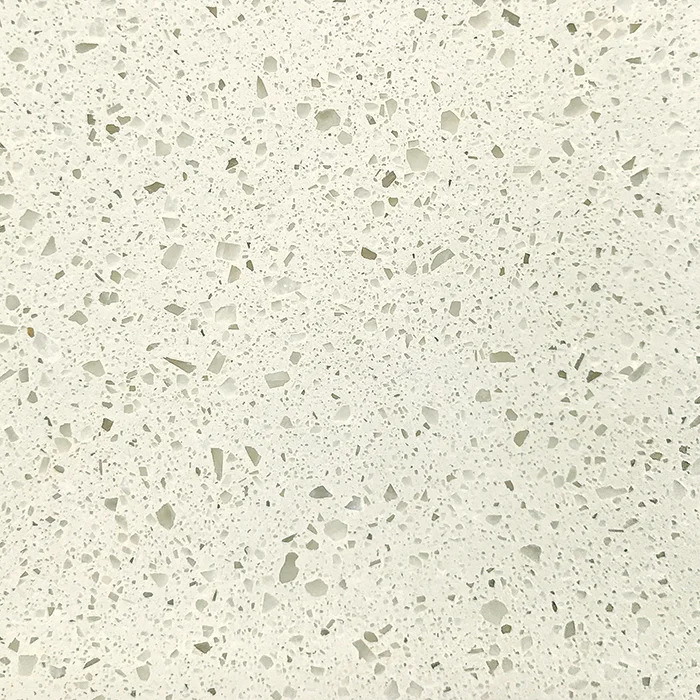
WAYON WT120 Summit Snow White Terrazo Sample
What Is Cast-in-Place Terrazzo?
Cast-in-place terrazzo is installed directly at the project site. The terrazzo mixture is poured over the prepared substrate, cured, ground, polished, and finished on location. This method is often used for large continuous flooring areas where designers want a monolithic surface effect.
It can be suitable for airports, schools, hospitals, museums, government buildings, transportation hubs, and large commercial floors. When installed by an experienced terrazzo contractor under the right site conditions, cast-in-place terrazzo can create a strong and elegant seamless floor.
Its challenge is that the final result depends heavily on site workmanship, substrate preparation, curing conditions, grinding quality, polishing control, and protection during construction. It usually requires a longer site process and more coordination than factory-made terrazzo products.
Precast Terrazzo vs Cast-in-Place Terrazzo at a Glance
The main difference between the two options is not only where the terrazzo is made. It also affects quality control, installation speed, site risk, design flexibility, and project management.
The following comparison helps architects, contractors, and procurement teams quickly evaluate which solution fits their project needs.
|
Comparison Factor |
Precast Terrazzo |
Cast-in-Place Terrazzo |
|
Production method |
Manufactured in factory |
Poured and finished on site |
|
Quality control |
More stable and controlled |
Highly dependent on site workmanship |
|
Site work |
Less cutting, grinding, and wet work |
More wet work, grinding, and polishing |
|
Installation speed |
Faster on-site installation |
Longer installation process |
|
Design consistency |
Easier to control color, size, and finish |
More affected by site conditions |
|
Best applications |
Slabs, tiles, stairs, walls, countertops, furniture surfaces |
Large seamless flooring |
|
Project risk |
Lower site uncertainty |
Higher site coordination risk |
|
Prefabrication fit |
Strong |
Limited |
In short, precast terrazzo offers better control, faster installation, and lower project risk, while cast-in-place terrazzo is mainly suitable for large seamless flooring with sufficient site conditions and skilled labor.
Why Precast Terrazzo Fits the Future of Construction
Modern construction is moving toward prefabrication, modular delivery, and faster installation. Hotels, commercial interiors, apartments, office buildings, overseas projects, and renovation projects often need materials that can be prepared before arriving on site. The less a project depends on local cutting, wet work, and complex site finishing, the easier it becomes to control schedule and quality.
Precast terrazzo responds well to this shift. Much of the production and fabrication work can be completed in the factory, while the job site focuses mainly on installation, alignment, fixing, joint treatment, and final protection. This makes the construction process closer to assembly instead of manufacturing on site.
Project teams also need more predictable delivery. Site conditions can change quickly, especially in overseas projects or fast-track commercial projects. Labor availability, local fabrication capability, weather, site access, and construction sequencing can all affect the final result. Precast terrazzo helps reduce these uncertainties because the material can be produced, checked, labeled, packed, and delivered according to project requirements.
Factory fabrication also reduces pressure on local contractors. When drawings are provided early, Wayon can support size cutting, edge processing, cutouts, stair parts, vanity tops, wall panels, countertops, and other custom terrazzo elements before shipment. This helps reduce site cutting, waste, dust, noise, and rework risk.
Key Advantages of Precast Terrazzo Over Cast-in-Place Terrazzo
Better Quality Control in Factory Production
One of the strongest advantages of precast terrazzo is factory quality control. In a controlled production environment, the manufacturer can manage raw material selection, binder proportion, aggregate size, color balance, curing, cutting, polishing, and surface inspection more consistently.
This is especially important for projects that require batch consistency across multiple areas, rooms, floors, or buildings. Hotels, apartment projects, retail chains, office interiors, and commercial developments often need materials that look consistent after installation.
Cast-in-place terrazzo can perform well, but its quality depends more heavily on site conditions. Substrate quality, temperature, humidity, installer experience, grinding equipment, polishing skill, and construction protection can all affect the finished surface. For projects that need more predictable results, precast terrazzo is easier to control.
Faster and Cleaner On-Site Installation
Precast terrazzo can significantly reduce the amount of work performed on site. Since the material is already manufactured and finished before delivery, the installation process mainly involves positioning, fixing, joint treatment, and final cleaning.
Compared with cast-in-place terrazzo, this can reduce wet work, curing time, grinding dust, polishing noise, and construction interference. It is especially useful for hotel renovations, commercial space upgrades, office fit-outs, retail stores, and projects with tight opening schedules.
Cast-in-place terrazzo usually requires more site time because it must be poured, cured, ground, polished, and protected in place. This can make scheduling more difficult when multiple trades are working in the same area.
Easier Fabrication for Slabs, Stairs, Walls, and Countertops
Cast-in-place terrazzo is mainly associated with flooring systems, especially large continuous floors. Precast terrazzo offers a wider range of fabricated product possibilities.
It can be processed into slabs, tiles, stair treads, risers, wall panels, countertops, vanity tops, reception desks, bar counters, tabletops, service counters, and custom furniture surfaces. This makes it useful not only as a flooring material, but also as a complete interior and architectural surface solution.
For project teams, this flexibility matters. A hotel may need terrazzo vanity tops, corridor wall panels, reception counters, and stair components. A retail space may need display tables, service counters, and brand wall features. With precast terrazzo, these elements can be fabricated according to drawings before delivery.
More Suitable for Overseas and Modular Projects
Overseas projects often face higher local labor costs, uncertain installer experience, longer coordination cycles, and limited access to specialized stone fabrication. Precast terrazzo helps reduce these risks because more work can be completed at the manufacturing stage.
For markets such as North America, Europe, the Middle East, and Australia, project teams often prefer materials that arrive with clearer dimensions, better packaging, and less need for local processing. This is especially important for contractors and procurement teams managing cross-border supply chains.
Precast terrazzo also fits modular construction and prefabricated buildings. Components can be produced according to drawings, labeled by area, packed for project sequence, and delivered for faster installation. This makes it suitable for modular hotels, prefab buildings, commercial renovation, temporary event spaces, RV parks, and fast-track development projects.
Better Control of Schedule and Project Coordination
Precast terrazzo allows material production and site preparation to move forward at the same time. While the construction site is being prepared, the factory can produce and fabricate terrazzo components in advance. Once the site is ready, finished components can be delivered and installed.
This helps reduce waiting time and improves project coordination. Contractors can plan installation more clearly because the material arrives closer to its final required form.
Cast-in-place terrazzo usually needs a longer site window. The floor area must be ready for pouring, curing, grinding, polishing, and protection. If other trades delay the site, the terrazzo work may also be delayed. If the terrazzo work takes longer than expected, it can affect following construction steps.
More Predictable Total Project Cost
Precast terrazzo is not always cheaper by material price, and cast-in-place terrazzo is not always more expensive. The real comparison should consider total project cost, including material, fabrication, labor, site time, equipment, protection, waste, rework, and maintenance.
Precast terrazzo can help reduce hidden costs caused by site delays, local processing errors, polishing inconsistency, or installation uncertainty. It can also reduce the need for specialized on-site terrazzo finishing in locations where skilled labor is limited or expensive.
For B2B projects, total cost of ownership often matters more than unit material price. A material that improves schedule control, reduces rework risk, and supports faster handover can bring stronger value to the whole project.

WAYON WT102 Summit Beige Terrazzo Sample
Where Cast-in-Place Terrazzo Still Makes Sense
Cast-in-place terrazzo still has a place in certain projects. It is especially suitable for large continuous floors where the design requires a seamless surface effect, custom floor patterns, or strong visual continuity across public areas.
Common applications include airports, schools, hospitals, museums, transportation hubs, government buildings, and large commercial flooring projects. In these spaces, a properly installed cast-in-place terrazzo floor can create a durable and impressive architectural surface.
The key condition is that the project must have experienced installers, enough site time, good substrate preparation, proper environmental control, and careful grinding and polishing management. Without these conditions, site-installed terrazzo can become more difficult to control.
For many modern projects beyond large seamless flooring, especially those involving walls, stairs, countertops, hotel interiors, modular elements, and overseas delivery, precast terrazzo provides a more flexible and controllable solution.
Best Applications for Precast Terrazzo
Hotel and Apartment Projects
Precast terrazzo works well in hotels and apartment projects because many areas require repeated dimensions and consistent finishing. It can be used for vanity tops, bathroom walls, corridor panels, reception desks, bar counters, stair treads, and custom furniture surfaces.
For hotel projects, faster installation and lower site disruption are important. Precast terrazzo allows many components to be prepared before arriving on site, helping contractors reduce local cutting and improve handover efficiency.
Commercial Interiors and Retail Spaces
Commercial interiors often need decorative materials that look refined, durable, and consistent across the space. Precast terrazzo can be used in shopping malls, retail stores, office lobbies, coffee shops, showrooms, service counters, brand walls, and display tables.
Because the material can be fabricated in advance, designers can create a coordinated surface language across floors, walls, counters, and furniture elements. This gives commercial spaces a more unified appearance while keeping installation more manageable.
Stairs, Wall Panels, and Architectural Details
Stairs and architectural details require accurate dimensions, good edge processing, and reliable surface finishing. Precast terrazzo is well suited for stair treads, risers, wall panels, columns, skirting, thresholds, ledges, and decorative elements.
Factory fabrication helps improve dimensional accuracy and edge quality. It also allows project teams to plan joint positions, installation sequence, and packaging more carefully before shipment.
Countertops, Vanities, and Furniture Surfaces
Precast terrazzo is not limited to flooring. It can also be used for countertops, vanity tops, washbasin counters, reception counters, bar counters, tabletops, and stone furniture surfaces.
This makes it useful for hospitality, retail, office, residential, and commercial projects that want terrazzo to appear as part of the whole interior design. Compared with site-poured terrazzo, precast terrazzo is easier to fabricate into finished components with controlled thickness, edge profiles, and openings.
Prefabricated and Fast-Track Construction
Precast terrazzo is highly suitable for prefabricated and fast-track construction. In prefab buildings, modular hotels, camping facilities, temporary event spaces, commercial renovations, and overseas projects, reducing site work is a major advantage.
Project teams can provide drawings, dimensions, application areas, and finish requirements in advance. The supplier can then manufacture and fabricate terrazzo components before delivery, helping the project reduce local cutting, shorten site work, and improve installation efficiency.
How Wayon Supports Precast Terrazzo Projects
Wayon supports precast terrazzo projects from material production to fabrication and delivery. As a stone manufacturer, Wayon can produce terrazzo slabs and tiles in different colors, aggregate sizes, finishes, and project specifications.
For projects that require more than standard slabs, Wayon can provide fabrication support based on drawings. This may include size cutting, edge processing, cutouts, stair parts, countertops, vanity tops, wall panels, reception counters, and other custom terrazzo components.
This one-stop support helps project teams reduce the pressure of local processing and site cutting. Instead of purchasing terrazzo material and arranging separate fabrication locally, contractors and procurement teams can work with one supplier for production, processing, quality checking, packaging, and export delivery.
Wayon can also support architects and contractors with samples, product information, technical data, shop drawing communication, packaging suggestions, and material recommendations according to the application area. For overseas projects, this type of coordinated support can make terrazzo specification and delivery more efficient.
How Architects, Contractors, and Developers Should Choose
For Architects
Architects should begin with the design intent and application area. If the project needs large seamless flooring, cast-in-place terrazzo may still be worth considering. If the design includes walls, stairs, counters, vanities, furniture surfaces, or modular components, precast terrazzo usually offers more practical flexibility.
Precast terrazzo also helps architects turn design ideas into buildable components. Color, aggregate size, slab dimension, joint position, finish, thickness, edge detail, and installation method can be reviewed before production, which makes the final result easier to control.
For Contractors
Contractors should focus on site conditions, installation sequence, local labor capability, substrate quality, access routes, protection requirements, and schedule pressure. Precast terrazzo can reduce on-site processing and help lower the risk of delays caused by wet work, grinding, polishing, or local fabrication issues.
For projects with tight schedules or limited local fabrication resources, factory-fabricated terrazzo components can make site management easier. Materials can be labeled, packed, and delivered according to project areas, helping contractors improve installation efficiency.
For Developers and Procurement Teams
Developers and procurement teams should evaluate total project value, not only material price. Delivery stability, batch consistency, packaging, installation efficiency, maintenance requirements, and rework risk all affect the final cost of a project.
For overseas projects, hotel developments, commercial interiors, apartments, and modular construction, precast terrazzo is often easier to manage. It allows more work to be completed before shipment and reduces uncertainty at the destination site.
Before choosing between precast terrazzo and cast-in-place terrazzo, project teams should ask several practical questions.
- Does the project require faster on-site installation?
- Can local workers handle cast-in-place terrazzo well?
- Is factory fabrication preferred?
- Are there stairs, walls, countertops, or custom elements?
- Does the project need batch consistency?
- Is the site schedule tight?
- Will overseas delivery or modular construction be involved?
What to Confirm Before Ordering Precast Terrazzo
Before ordering precast terrazzo, project teams should prepare clear technical and design information. This helps the supplier recommend the right material, control fabrication details, and reduce communication gaps during production.
Important information includes drawings, dimensions, application areas, preferred colors, aggregate size, thickness, surface finish, edge details, cutouts, openings, quantity, packaging requirements, delivery destination, installation method, and technical performance requirements.
Terrazzo should not be selected only from a small sample. Aggregate size, background color, gloss level, slab size, lighting, and viewing distance can all affect the final appearance. For larger projects, it is useful to review physical samples, large slab photos, finish samples, and fabrication details before final confirmation.
Wayon can support project teams by reviewing application requirements and providing terrazzo material selection, sample support, fabrication guidance, and delivery suggestions.
Frequently Asked Questions
Is precast terrazzo better than cast-in-place terrazzo?
Precast terrazzo is often better for projects that need faster installation, factory quality control, reduced site work, and custom fabricated components. Cast-in-place terrazzo is still suitable for large seamless floors where the project has enough site time and experienced installers.
Why is precast terrazzo becoming more popular?
Precast terrazzo is becoming more popular because construction projects are moving toward prefabrication, faster delivery, and more predictable quality. It allows terrazzo slabs and components to be produced and fabricated before arriving on site, which reduces wet work, local cutting, and installation uncertainty.
What is the main difference between precast terrazzo and cast-in-place terrazzo?
Precast terrazzo is manufactured in a factory and then installed on site. Cast-in-place terrazzo is poured, cured, ground, and polished directly at the project site. This difference affects schedule, quality control, site work, application range, and project risk.
Is precast terrazzo suitable for flooring?
Yes. Precast terrazzo tiles and slabs can be used for commercial flooring when the correct thickness, finish, slip resistance, substrate, and installation method are specified. It is especially useful when a project needs faster installation and more controlled material quality.
Can precast terrazzo be used for countertops and wall panels?
Yes. Precast terrazzo is suitable for countertops, vanity tops, wall panels, stair treads, reception desks, bar counters, tabletops, and other custom fabricated elements. This is one of its key advantages over cast-in-place terrazzo, which is mainly used for flooring.
Does cast-in-place terrazzo take longer to install?
In most cases, yes. Cast-in-place terrazzo requires on-site pouring, curing, grinding, polishing, and protection. This usually takes longer than installing factory-made terrazzo slabs or tiles, and the final result depends heavily on site conditions and installer experience.
Is precast terrazzo good for prefab construction?
Yes. Precast terrazzo fits prefabricated and modular construction because slabs and components can be manufactured and fabricated before delivery. This helps reduce local cutting, shorten installation time, and make the project easier to manage on site.
What information is needed for a precast terrazzo quotation?
Project teams should provide drawings, application areas, preferred colors, aggregate size, thickness, finish, dimensions, edge details, cutouts, quantity, project location, delivery destination, and schedule. This helps the supplier recommend the right terrazzo solution and prepare a more accurate quotation.
Which is more cost-effective: precast or cast-in-place terrazzo?
It depends on the project. Precast terrazzo often reduces total project cost by lowering labor, installation time, and rework risk.
Is precast terrazzo durable for commercial use?
Yes, when properly specified, precast terrazzo offers excellent durability, making it suitable for high-traffic commercial environments.
Conclusion
Looking for a reliable precast terrazzo manufacturer for your next project?
Wayon Stone provides factory-direct terrazzo slabs, tiles, and custom fabricated solutions with global export support. Contact us for samples, technical data, and project consultation.