

Why Australia Is Moving Away from High Silica Quartz
Two years after Australia became the first country to ban engineered stone with more than 1 percent crystalline silica, the results are in — and they are reshaping the global quartz industry faster than almost anyone predicted.
The ban, which took full effect on July 1, 2024, was initially met with skepticism. Critics warned of supply shortages, price spikes, and a wave of non-compliant black-market imports. None of that materialized. Instead, the Australian market has undergone a clean and remarkably rapid transition to zero-silica engineered stone. New cases of silicosis among fabricators have dropped sharply. Compliant products are widely available. And the regulatory model Australia pioneered is now being adopted — or actively considered — by governments across Europe, North America, and Asia.
For distributors, importers, and specifiers outside Australia, the question is no longer whether a similar shift will reach their market. It is how fast, and whether they will be ready when it does.
Two Years After the Ban: What Actually Happened
The Transition Was Faster Than Expected
When the ban was announced in late 2023, the engineered stone industry had less than eight months to prepare. Many predicted chaos. Instead, manufacturers moved with surprising speed.
Chinese producers — already the world's largest exporters of engineered stone — led the charge. Companies like WAYON STONE, which had been developing low-silica formulations since the early 2020s, were able to bring compliant zero-silica products to market within months. Indian and Turkish manufacturers followed. By mid-2024, the Australian market had a steady supply of compliant engineered stone, and prices had stabilized within 10 to 15 percent of pre-ban levels.
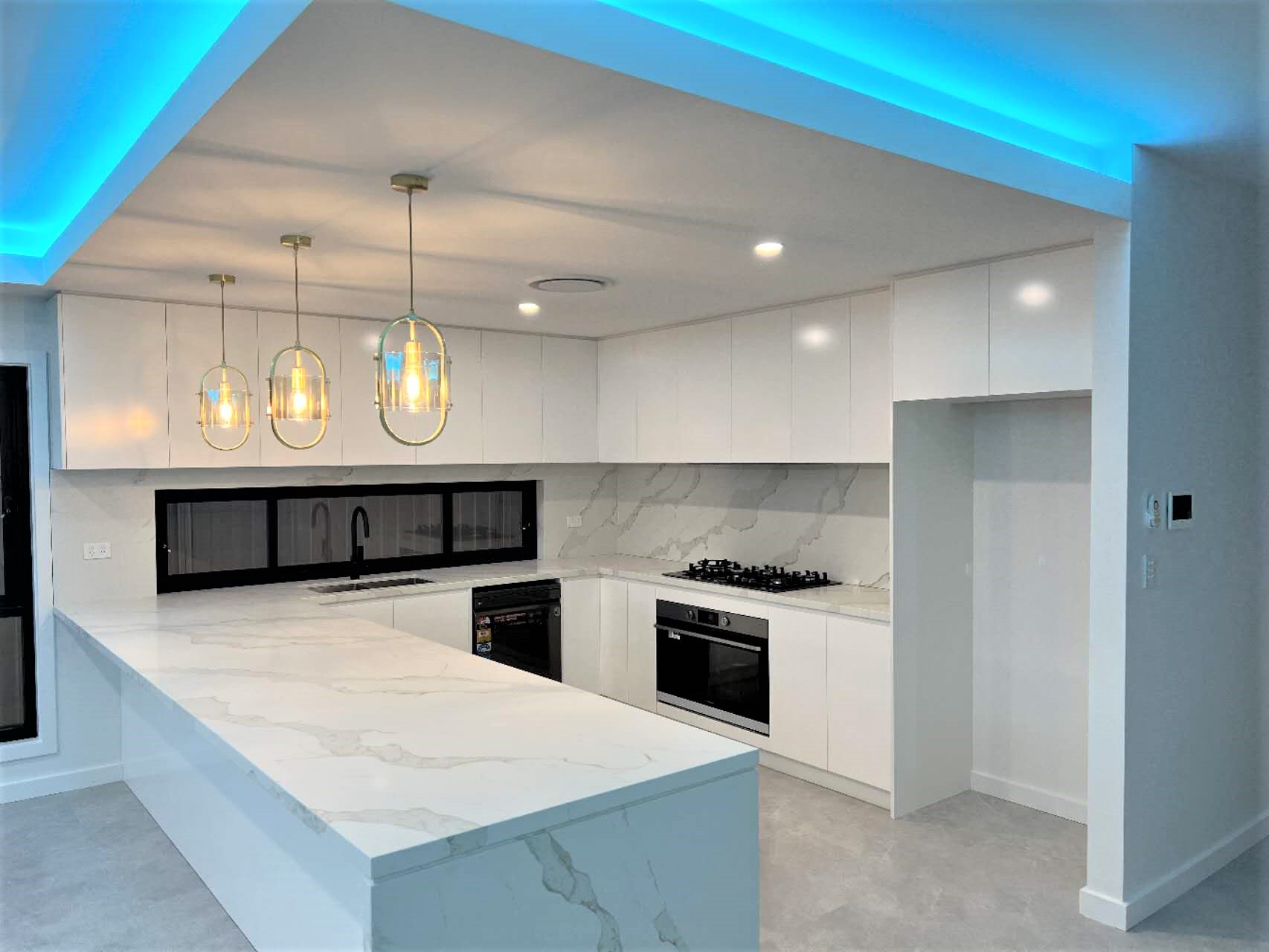
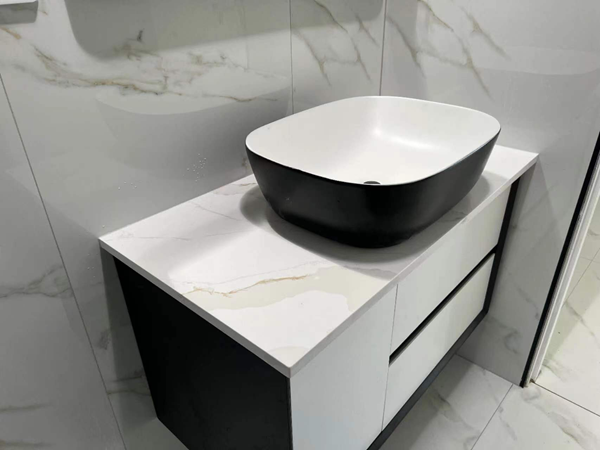
WAYON STONE project of zero silica in Australia
The transition was not painless. Some smaller fabricators who relied on cheap, high-silica imports struggled to adapt. A handful went out of business. But the industry as a whole absorbed the shock far better than the doomsayers had predicted.
Silicosis Rates Are Dropping
The entire point of the ban was to prevent disease, and early data suggests it is working. Australian health authorities have reported a significant decline in new silicosis diagnoses among engineered stone workers since 2024. Fabricators who previously worked with high-silica materials in poorly ventilated shops are now handling zero-silica products that generate minimal respirable dust.
The contrast with the pre-ban era is stark. Between 2015 and 2023, Australia documented over 600 cases of silicosis in engineered stone workers — many of them under 40. The disease was progressing faster than traditional silicosis, killing young men who had spent less than a decade in the trade. That pipeline of new cases has now been cut off at the source.
Compliance Has Been Effective
One of the biggest concerns about the ban was enforcement. Australia's engineered stone supply chain is complex, with imports flowing through multiple intermediaries before reaching fabricators. Could regulators really prevent non-compliant products from entering the market?
The answer, so far, is yes. Safe Work Australia and state regulators have conducted regular inspections at ports, warehouses, and fabrication shops. Penalties for supplying or installing non-compliant engineered stone have been significant enough to deter most violations. The black market that some predicted has not materialized at scale — largely because compliant zero-silica products are now competitively priced and widely available.
Global Impact of Australia Silica Quartz Ban
The United Kingdom Is Next
The UK's Health and Safety Executive (HSE) launched a formal investigation into silica risks in engineered stone in 2024. In early 2026, the HSE published its findings: a clear recommendation for regulatory action similar to Australia's ban. Industry sources expect the UK to implement its own restrictions on high-silica engineered stone by late 2026 or early 2027.
The UK market is smaller than Australia's, but its regulatory influence extends across the Commonwealth and into European supply chains. A UK ban would effectively close another major market to high-silica products and accelerate the global shift toward zero-silica formulations.
California Is Moving
California's Occupational Safety and Health Standards Board (Cal/OSHA) has been tightening silica exposure limits for years. In 2025, Cal/OSHA proposed new regulations specifically targeting engineered stone fabrication, including mandatory dust control measures and medical surveillance for workers.
While California has not yet proposed a full ban, the direction of travel is clear. California is the fifth-largest economy in the world. Any regulatory action it takes on engineered stone will reshape the North American market — and likely set a precedent for other U.S. states.
Europe Is Watching
The European Union is reviewing its Carcinogens and Mutagens Directive with engineered stone squarely in focus. Several EU member states — including Germany, France, and the Netherlands — have already tightened national silica exposure limits beyond the EU minimum. A coordinated EU-level restriction on high-silica engineered stone is considered likely within the next three to five years.
Singapore and the Middle East
Singapore's Ministry of Manpower has flagged engineered stone as a priority hazard and introduced mandatory health surveillance for workers handling high-silica materials. In the Middle East — a major market for quartz countertops — several large-scale developers have begun specifying zero-silica materials in their projects, driven by both health concerns and sustainability commitments.
Zero-Silica Quartz Stone: Specs & Performance in 2026
The zero-silica quartz category has matured significantly since the ban. In 2024, early products were limited in color range and pattern options. By 2026, the situation has changed dramatically.
Today's zero-silica quartz is available in dozens of colors and patterns, from classic marble-look whites to bold veined designs and subtle neutral tones. The performance specifications match or exceed traditional quartz: Mohs hardness 7, flexural strength above 45 MPa, water absorption below 0.02 percent. The only difference is the silica content — and the absence of health risk.
WAYON STONE, a Chinese quartz manufacturer with over four decades of experience, has been at the forefront of this transition. Its zero-silica quartz line includes 27 patterns in polished and matte finishes, available in standard (3000×1400mm) and jumbo (3200×1600mm) formats with thickness options of 18mm, 20mm, and 30mm. All products carry ISO 9001, CE, NSF, and Greenguard Gold certifications — and, critically, meet Australia's 1 percent silica threshold with room to spare.
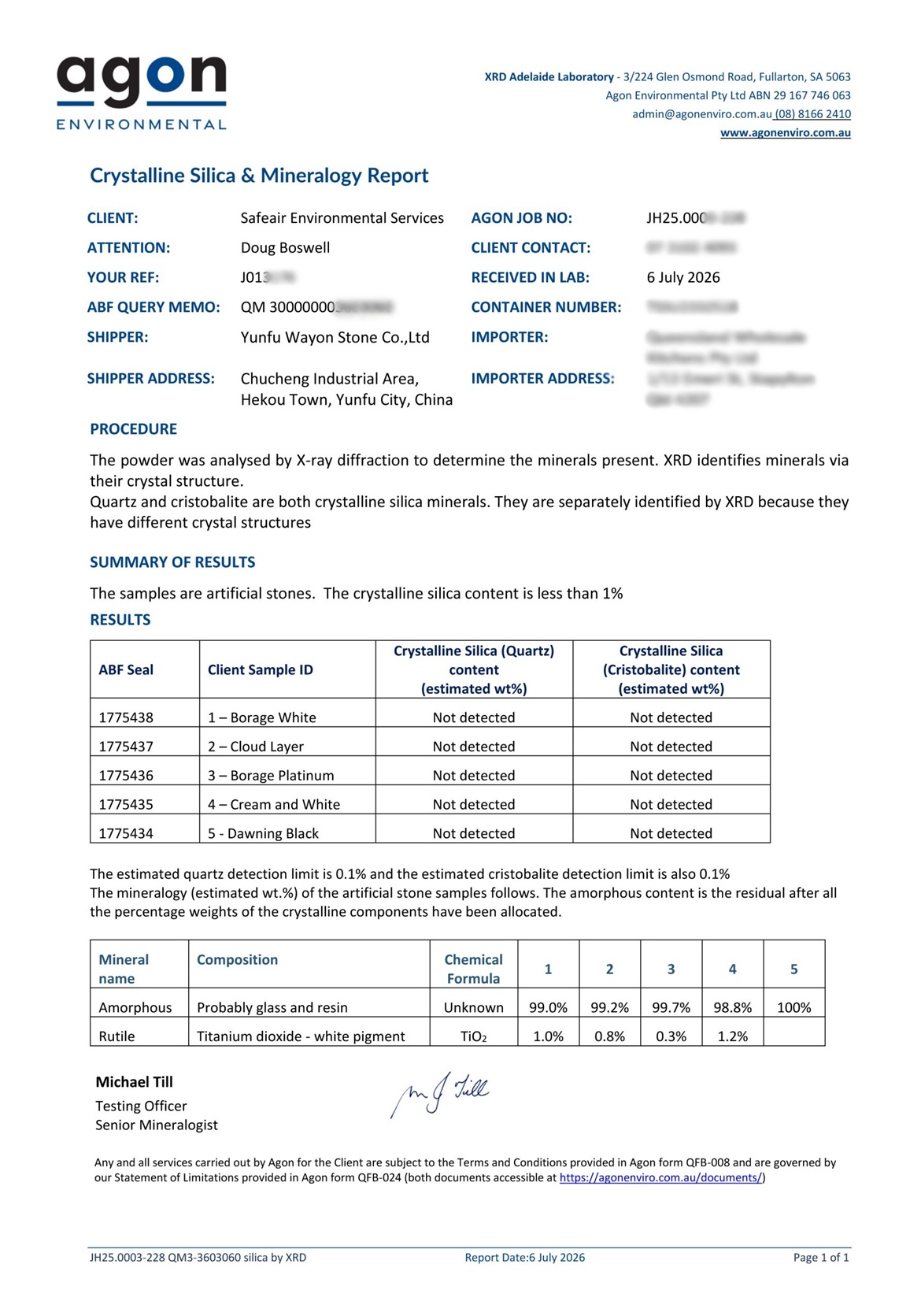
Wayon Zero-Silica Stone Test Report Austrila
For fabricators, the shift to zero-silica quartz has been transformative. They no longer need expensive dust extraction systems, wet cutting protocols, or regular medical monitoring. The material cuts and polishes like traditional quartz — but without the cloud of silica dust that made the trade so dangerous.
What This Means for Buyers in 2026
If you are a distributor, importer, or specifier operating outside Australia, here is where things stand in mid-2026.
The transition is already happening.
Global production capacity for zero-silica quartz has expanded dramatically since 2024. Major manufacturers in China, India, and Turkey now offer zero-silica lines as standard. High-silica products are becoming a legacy category — still available, but increasingly hard to justify from a regulatory and reputational standpoint.
Regulatory risk is real and growing.
The UK is expected to act within a year. California is tightening rules. The EU is reviewing its directive. If you are sourcing high-silica engineered stone for a market that has not yet regulated it, you are running a timer — not a permanent arrangement.
The cost gap has narrowed.
In 2024, zero-silica quartz carried a 15 to 25 percent premium over traditional high-silica products. By 2026, that premium has narrowed to 5 to 10 percent for most product lines, and some manufacturers have achieved price parity on select colors. As production scales continue to grow, further price convergence is expected.
Buyers are starting to ask.
Architects, designers, and end clients are increasingly aware of the silica issue. Specifications that do not address silica content are becoming less common in commercial projects. Distributors who can offer compliant zero-silica products have a clear competitive advantage.
Conclusion
Australia's ban on high-silica engineered stone was not a one-off policy experiment. It was the first domino in a global regulatory shift that is now well underway. Two years in, the results speak for themselves: the transition worked, silicosis rates are dropping, and the rest of the world is following.
For commercial buyers, the message in 2026 is clearer than ever. High-silica quartz is a declining product category. Zero-silica alternatives are the new standard. The question is not whether to switch — it is whether you make the move now, on your terms, or later, under regulatory pressure.
Frequently Asked Questions
Is engineered stone completely banned in Australia?
Not entirely. The ban applies to engineered stone containing 1 percent or more crystalline silica. Zero-silica and silica-free engineered stone products that meet the threshold are still legal to supply and install.
How has the Australian market adapted since the ban?
The transition has been smoother than expected. Compliant zero-silica products are widely available, prices have stabilized within 10 to 15 percent of pre-ban levels, and new silicosis cases among fabricators have dropped significantly.
Will other countries follow Australia's ban?
Yes. The UK is expected to implement similar restrictions by late 2026 or early 2027. California is tightening regulations. The EU is reviewing its silica directives. Singapore has introduced mandatory health surveillance. More markets are expected to follow.
Is zero-silica quartz as durable as traditional quartz?
Yes. Modern zero-silica quartz delivers the same Mohs hardness (7), flexural strength (above 45 MPa), and water absorption (below 0.02 percent) as traditional engineered stone. The only difference is the silica content.
How much more does zero-silica quartz cost in 2026?
The premium has narrowed significantly. Most zero-silica products are now priced 5 to 10 percent above comparable traditional quartz, with some colors achieving price parity. Further convergence is expected as production scales grow.
Can I still import traditional high-silica engineered stone?
You can, but the window is closing. The UK and California are expected to act within one to three years. Distributors who transition early gain a competitive advantage. Those who wait risk being caught with non-compliant inventory.
How can I verify that a quartz product meets Australia's silica standard?
Request material safety data sheets (MSDS) and independent laboratory test results from your supplier. Reputable manufacturers like WAYON STONE provide third-party certification documents on request.
How is your responding to the "Engineered Stone Ban" in Australia and upcoming global silica regulations?
In response to the engineered stone ban in Australia and tightening silica regulations in the UK and USA, we has pioneered a compliant Zero Silica Quartz line. Our products contain 0% crystalline silica, far exceeding the 1% threshold required by the ban, ensuring a 100% silica dust-free environment for fabricators and meeting the highest occupational health standards worldwide.
Does Zero Silica Quartz maintain the same performance and durability as traditional engineered stone?
Yes. Despite the elimination of crystalline silica, our Zero Silica Quartz maintains exceptional physical properties, including a Mohs hardness of 6–7 and a water absorption rate of less than 0.05%. The material offers a flexural strength above 45 MPa and thermal stability up to 300℃, ensuring it matches or exceeds the durability and stain resistance of traditional quartz for high-traffic commercial and residential applications.
What makes your Zero Silica stone a sustainable and eco-friendly choice?
Our Zero-Silica products are crafted using recycled glass or amorphous silica, significantly reducing the environmental footprint compared to traditional quarrying. The material is non-toxic, non-radioactive, and holds prestigious international certifications, including Greenguard Gold, NSF, and CE, making it an ideal "green stone" solution for sustainable projects aiming for LEED or similar green building credits.