

Why Flexible Stone Is Ideal for Curved Wall Cladding
Curved walls bring a distinctive sense of movement and depth to architectural spaces. They are increasingly used in hotels, retail environments, restaurants, offices, and contemporary residential projects where a continuous architectural form is part of the design concept. The cladding material, consequently, needs to respond to geometry as carefully as it responds to appearance and durability.
Flexible stone is particularly well suited to this type of application. Its thin construction and flexible structure allow stone surfaces to adapt to curved architectural forms while retaining the natural character of stone. The result is a cladding approach that connects material expression with the geometry of the wall.
What Makes Curved Wall Cladding Different?
Curved surfaces require cladding materials to respond continuously to changing geometry. Several factors become particularly important when selecting a suitable solution.
Surface continuity affects the overall appearance. Excessive segmentation can create frequent joints and interrupt the visual flow of a curved wall.
Bending capability needs to match the actual radius of the surface. The minimum bending radius is therefore an important technical specification.
Installation practicality also matters. Weight, sheet dimensions, cutting requirements, and fixing methods can influence handling and positioning during installation.
Visual consistency deserves attention as well. Texture, color variation, vein direction, and panel alignment can become more noticeable across a curved surface.
Why Flexible Stone Fits the Geometry of Curved Walls
The suitability of flexible stone for curved wall cladding comes from the relationship between its physical structure and the geometry of the surface. Its thin profile allows the material to conform to a designed radius with less structural resistance, creating greater freedom when working with rounded architectural forms. This characteristic becomes especially valuable when the curve is a defining feature of the space.
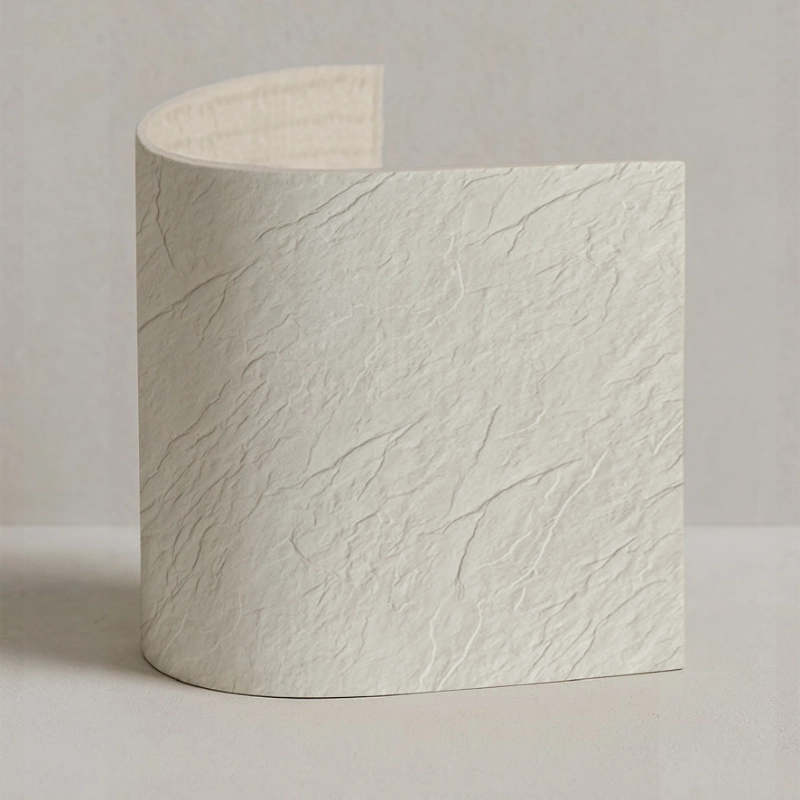
WAYON MC404 Slate flexible stone
It Follows the Curve More Naturally
Rigid stone cladding generally relies on individual pieces that are cut and positioned to approximate a curved surface. Each additional segment introduces another joint and another point that requires precise alignment. Flexible stone can conform more continuously to the wall, allowing the cladding to follow the intended geometry with fewer interruptions.
This approach is particularly effective on feature walls, rounded corners, columns, and other surfaces where maintaining the original architectural contour is central to the design.
Thin Construction Supports Formability
Flexible stone is produced in a thin format, which contributes directly to its ability to adapt to curved surfaces. A thinner material requires less force to conform to a given radius, making controlled bending more practical during installation.
WAYON flexible stone products are available in different thickness specifications, allowing the material to be selected according to project requirements. The appropriate thickness should always be considered alongside the wall radius, substrate condition, and intended application.
Adaptability Across Different Curves
Curved architecture can include convex surfaces, concave sections, rounded corners, arches, and cylindrical forms. Flexible stone can accommodate many of these geometries when the required radius falls within the material's specified bending range.
This adaptability gives designers greater freedom to incorporate stone into architectural forms that would require more complex fabrication with rigid materials. The final selection should be based on the actual curve dimensions and technical specifications of the selected product.
Flexible Stone Creates More Continuous Stone Cladding
Curved walls often serve as prominent visual elements, making the relationship between surface texture and architectural form especially important.
Flexible stone can reduce unnecessary visual interruptions by allowing larger cladding sections to follow suitable curves. This creates a smoother surface and allows the architectural form to remain visually prominent.
The stone texture itself can also become part of the design. Natural variations, veins, and surface patterns can extend across the curve, creating a stronger connection between material expression and architectural geometry.
This is particularly useful for feature walls, rounded corners, columns, and transitions where excessive segmentation could distract from the intended design.
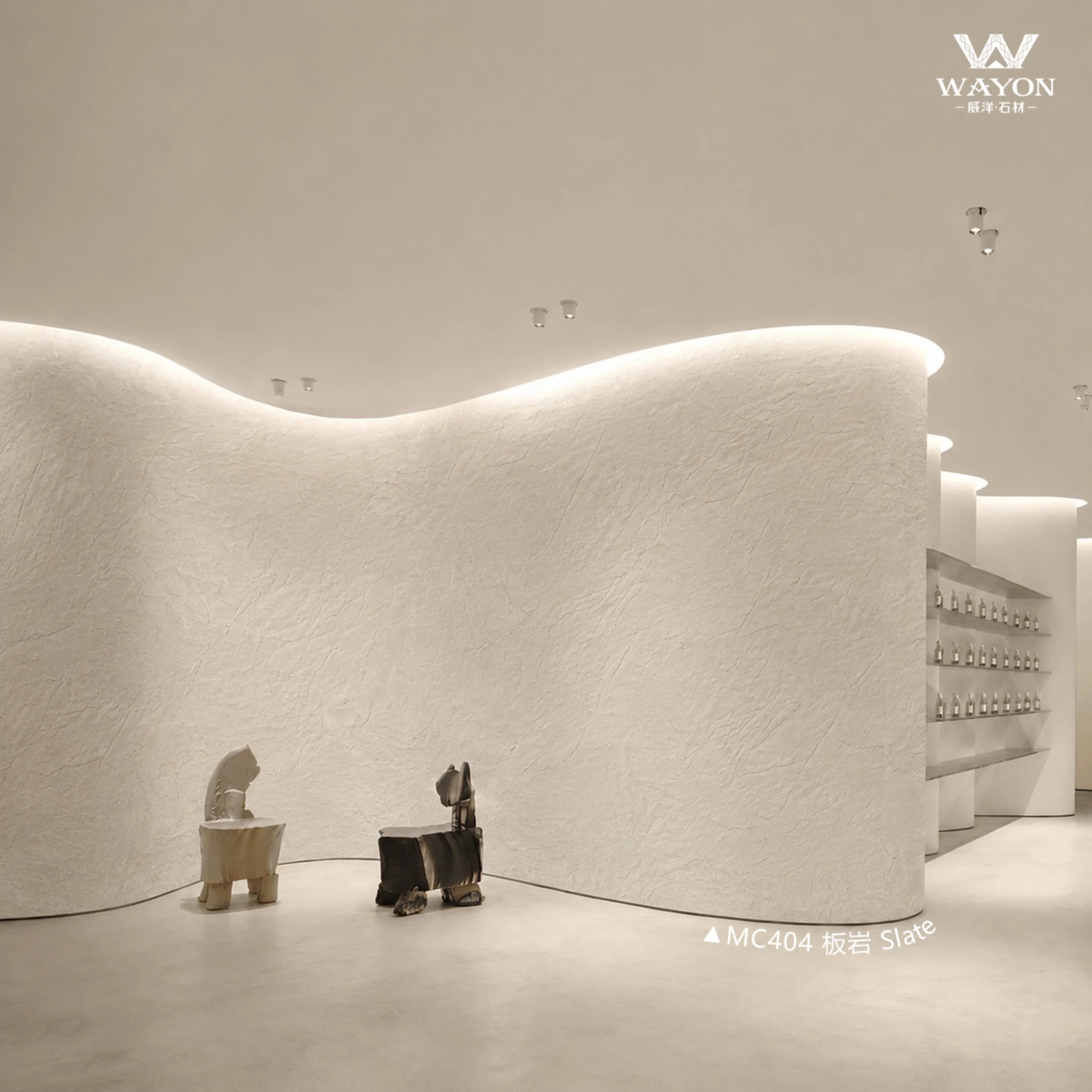
Flexible Stone vs. Rigid Cladding on Curved Walls
The differences between flexible and rigid cladding become more apparent as the complexity of the curve increases.
|
Consideration |
Rigid Stone |
Flexible Stone |
|
Curved geometry |
Often requires segmentation |
Conforms more readily to suitable radii |
|
Fabrication |
More specialized cutting may be required |
Generally simpler to process |
|
Joints |
More sections can mean more joints |
Larger continuous sections may be possible |
|
Handling |
Greater weight |
Lightweight format |
|
Design flexibility |
More dependent on fabrication |
Greater freedom for rounded forms |
Rigid stone remains appropriate for many projects. Flexible stone becomes particularly valuable when curved geometry, visual continuity, and installation practicality are major design considerations.
Where Flexible Stone Works Best in Curved Wall Projects
Flexible stone is especially effective where the curve forms an important part of the architectural concept. Common applications include curved feature walls in hotels, restaurants, retail spaces, and offices, as well as rounded columns, pillars, arches, and selected exterior facades.
It can also be considered for renovation projects where limited access, existing structural loads, or construction disruption make lightweight cladding advantageous.
The most suitable application depends on the curve, substrate, environmental conditions, and product specification.
What to Check Before Choosing Flexible Stone for a Curved Wall
A successful project starts with accurate technical information. Five factors deserve particular attention.
1. Minimum bending radius
Measure the actual wall radius and compare it with the product's specified bending capability. Some WAYON flexible stone solutions can achieve a minimum radius of approximately 15 cm, depending on the product and specification.
2. Surface condition
The substrate should be stable, clean, and suitable for bonding. Surface preparation may be required where unevenness or deterioration exists.
3. Sheet size
Larger sheets can reduce visible joints, while manageable dimensions can provide better control on complex curves.
4. Texture direction
Vein direction, pattern repetition, and sheet orientation should be planned before installation to achieve a consistent appearance.
5. Application environment
Interior and exterior projects may have different requirements. Moisture, UV exposure, temperature variation, and adhesive compatibility should be evaluated during product selection.
How Flexible Stone Changes the Economics of Curved Wall Projects
The cost of curved wall cladding involves more than material price. Fabrication, transportation, handling, cutting, labor, and installation time can all affect the final project budget.
Flexible stone can improve overall project efficiency through its lightweight format and adaptability to suitable curves. Less specialized fabrication and easier material handling can simplify installation and reduce labor-intensive operations in appropriate applications.
Its economic value therefore comes from the complete project process. Evaluating fabrication, logistics, and installation together provides a clearer picture of its potential advantages.
Is Flexible Stone the Right Choice for Every Curved Wall?
Flexible stone is well suited to many curved cladding applications, but product selection should always reflect the actual project conditions. Tight curves require verification of the minimum bending radius, while exterior applications may involve additional requirements for moisture, UV exposure, temperature variation, and adhesive performance.
Architects, contractors, and buyers should confirm the wall radius, substrate, dimensions, application environment, and installation system before ordering. Project-specific technical consultation can help ensure that the selected material matches the intended design.
Conclusion
Curved walls require a cladding material that can respond to architectural geometry while maintaining the visual character of stone. Flexible stone provides this combination through its thin construction, adaptable format, manageable weight, and natural surface texture. Its ability to conform to suitable curves also creates greater freedom for feature walls, columns, arches, selected facades, and renovation projects.
For architects, designers, contractors, and stone distributors planning curved wall projects, WAYON offers flexible stone solutions in different textures, thicknesses, sizes, and specifications. Contact WAYON to discuss your project requirements and find a flexible stone solution suited to your wall geometry, design concept, and application environment.
FAQ
What is the minimum bending radius of flexible stone for curved walls?
The minimum bending radius varies by product, thickness, and construction. Some WAYON flexible stone solutions can achieve a radius of approximately 15 cm. The actual wall radius should be checked against the technical specification of the selected product before ordering.
Can flexible stone be installed on both concave and convex walls?
Yes. Flexible stone can be adapted to suitable concave and convex surfaces when the wall geometry falls within the product's specified bending range. Surface preparation and installation conditions should also be evaluated before application.
Does flexible stone require joints on curved walls?
Joints may still be required depending on sheet dimensions, wall size, curve geometry, and the desired design pattern. Larger sheets can help reduce the number of visible joints and create a more continuous stone appearance.
Can flexible stone wrap around columns and arches?
Flexible stone is suitable for many rounded columns, pillars, arches, and similar architectural elements. The specific bending radius and substrate conditions should be confirmed to ensure the selected product can conform properly to the shape.
Is flexible stone suitable for exterior curved wall cladding?
Selected flexible stone products can be used for exterior applications when their technical specifications match the environmental conditions. UV exposure, moisture, temperature changes, substrate stability, and adhesive compatibility should all be considered during material selection.
How should the wall radius be measured before ordering flexible stone?
The actual curved surface should be measured carefully to determine its radius, dimensions, and transitions. For complex architectural forms, providing drawings, dimensions, or project specifications to the manufacturer can help confirm material suitability and determine the appropriate product configuration.